
- Translator
- Nevil Maskelyne
Nevil Maskelyne and the 1903 radio hack
Nevil Maskelyne interrupted a Royal Institution demonstration of Marconi's wireless in June 1903 with Morse beginning with repeated RATS. The incident challenged claims of secure communication (Royal Institution).
The interruption challenged a promise of secure wireless (Royal Institution). Distinguish hearing or injecting a message from decrypting one when you read accounts of the demonstration.
What happened in the Marconi hack of 1903?
John Ambrose Fleming was preparing to receive a wireless message in London from Guglielmo Marconi in Cornwall. Before the expected message arrived, the apparatus tapped out an unwelcome one. The Royal Institution says the repeated word came first; the mocking verse followed. The unwanted transmission stopped shortly before Marconi's signal arrived (Royal Institution).
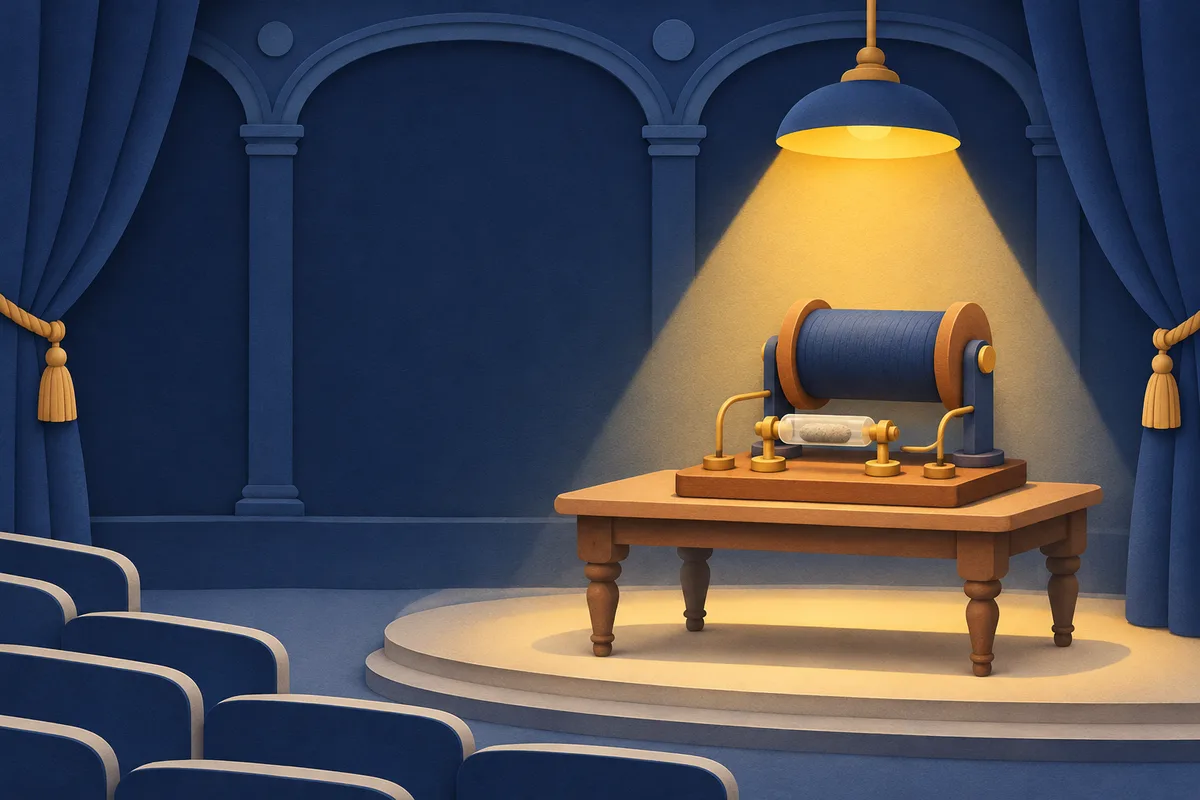
That sequence matters. The incident was not simply a failed attempt to hear a distant station. Someone else had supplied recognizable words to the receiving apparatus. WNYC's published interview with science journalist Paul Marks independently describes the repeated word and the interruption before Fleming's demonstration (WNYC Studios, On the Media).
Keep this episode separate from Marconi's reported transatlantic signal. When you compare historical demonstrations, ask what each was meant to establish. Reaching a receiver, keeping a message private and excluding an unwanted sender are different tests. Success at one does not establish the others.
Who was Nevil Maskelyne?
Maskelyne was a British magician and inventor who experimented with wireless communication (Royal Institution). Marks describes him as a technical rival frustrated by Marconi's patent control. The interview also places his work in a commercial contest: cable telegraph interests feared competition from wireless and supported his investigation (WNYC Studios, On the Media).
That background gives you a reason to distinguish the result from the motive. A rival can expose a real weakness while benefiting from the embarrassment. You do not need to treat the intervention as disinterested public service to recognize the problem it demonstrated. Equally, a commercial motive does not make the received words disappear.
Hear the confirmed word: RATS
Both accounts identify RATS as the repeated opening word (Royal Institution) (WNYC Studios, On the Media). The player sends it once, using today's International Morse alphabet. It is a fresh learning example, not audio from the lecture hall. The letter patterns follow the ITU's International Morse table (ITU-R M.1677-1, Annex 1).
Follow R, A, T and S in the Morse code alphabet. Then look away and try to copy the word by ear. If you need a smaller exercise, enter an individual letter in the Morse code translator. Keep the task to recognizing the letters; identifying a sender is a separate question.
Why did it embarrass the secrecy claims?
In the WNYC interview, Marks explains the weakness plainly: other people could tune in, intercept messages or transmit their own. Marconi's claim that outsiders could not listen made the unwanted transmission especially damaging (WNYC Studios, On the Media).
The Royal Institution also describes an earlier interception experiment by Maskelyne. That listening experiment and the later interruption are separate pieces of its account (Royal Institution). Receiving someone else's traffic tests privacy. Making another receiver accept your words tests whether an outsider can intrude. Avoid collapsing them into a single act of codebreaking.
The practical lesson is conditional: anyone within reception range with suitable receiving equipment can potentially hear an unencrypted radio message. Tuning is a way to select a signal, not a promise that only an intended recipient can receive it. This is the implication of the interception described by Marks (WNYC Studios, On the Media).
Was the interference decryption?
No. NIST defines encryption as a cryptographic transformation that conceals the original meaning of data (NIST). Decryption reverses that transformation (NIST). Sending unwanted Morse into a receiver does not, by itself, show that an attacker recovered concealed text.
Use a simple thought experiment. Suppose you and a friend agree to exchange an ordinary word. A third person hears it. That is an interception. Now suppose the third person sends a different word that your friend hears instead. That is an intrusion into the exchange. Neither example requires an encrypted text to be solved.
“Hack” is a modern shorthand for the interruption.
Read the accounts and test the claim
Start with the host institution's account, then compare the published WNYC transcript. Look for the expected sender, the unexpected words and the claim each account says was challenged. Notice whether a detail concerns listening, transmitting or interpreting the result. That reading method keeps a memorable prank from becoming a misleading story about encryption.
Use other documented Morse messages for comparison. For the wired system discussed in the accounts, see how the telegraph worked. The operator's side of that era appears in why radio operators were called Sparks. For your own listening exercise, learn Morse by ear and practice copying the word before checking the letters.
Sources
- History's first public hack: rats, rats, rats!. Royal Institution, checked 20 November 2026.
- The Gentleman Hacker of 1903. WNYC Studios, On the Media, 13 January 2012.
- Encryption, CSRC Glossary. NIST, checked 20 November 2026.
- Decryption, CSRC Glossary. NIST, checked 20 November 2026.
- Recommendation ITU-R M.1677-1, International Morse code. ITU Radiocommunication Sector, October 2009.