
- Translator
- Enigma machine facts
Enigma machine facts: where Morse fits
Enigma was a cipher machine that scrambled letters. German radio operators sent its ciphertext in Morse, so copying the signals and breaking the encryption were separate tasks (The National Museum of Computing), (GCHQ).
Enigma scrambled letters; Morse carried them. Enigma was an electromechanical cipher machine used by German forces during World War II. Its rotors changed readable text into enciphered text. Radio operators could then send those letters in Morse. Learning Morse let an interceptor copy the letters, but recovering their meaning required a separate codebreaking effort (The National Museum of Computing), (GCHQ).
What was the Enigma machine used for?
Enigma protected communications by substituting letters through an electrical and mechanical system. Plaintext means the readable original; ciphertext means the transformed text. The receiver needed the appropriate settings to reverse the process. The National Museum of Computing describes a daily key specifying wheel order, ring settings and plugboard connections (The National Museum of Computing).
Enigma also had a commercial beginning. German engineer Arthur Scherbius developed it for business use before the military adaptations. The National Museum of Computing distinguishes the commercial machine from military versions with an added plugboard (National Museum of Computing, machine history).
When you describe its purpose in a school project, use two separate verbs: the machine enciphered the text and the radio operator transmitted it. That wording helps you follow the message through the next stages.
How did Enigma work?
Enigma transformed a typed letter by sending electrical current through the plugboard, entry wheel and scrambling wheels to a reflector, then back through the wheels and plugboard to light a letter on the lampboard. The wheel positions changed as the operator typed (National Museum of Computing, electrical path).
| Part | What it did |
|---|---|
| Keyboard | Accepted the input letter. |
| Plugboard | Connected letters in pairs. |
| Rotors | Routed current through wired substitutions. |
| Reflector | Returned current through the rotors. |
| Lampboard | Displayed the resulting letter. |
The table describes the same electrical path (National Museum of Computing, machine components). For the distinction between an alphabet and a secret-key system, use Morse encoding and ciphers.
Did Enigma use Morse code?
Enigma messages were sent in Morse, and Allied listeners copied them before codebreakers worked on the encryption. GCHQ documents this through Pamela Hussey's wartime service at the Irton Moor listening post near Scarborough. She and her colleagues transcribed German Enigma traffic carried in Morse and passed it to Bletchley Park (GCHQ).
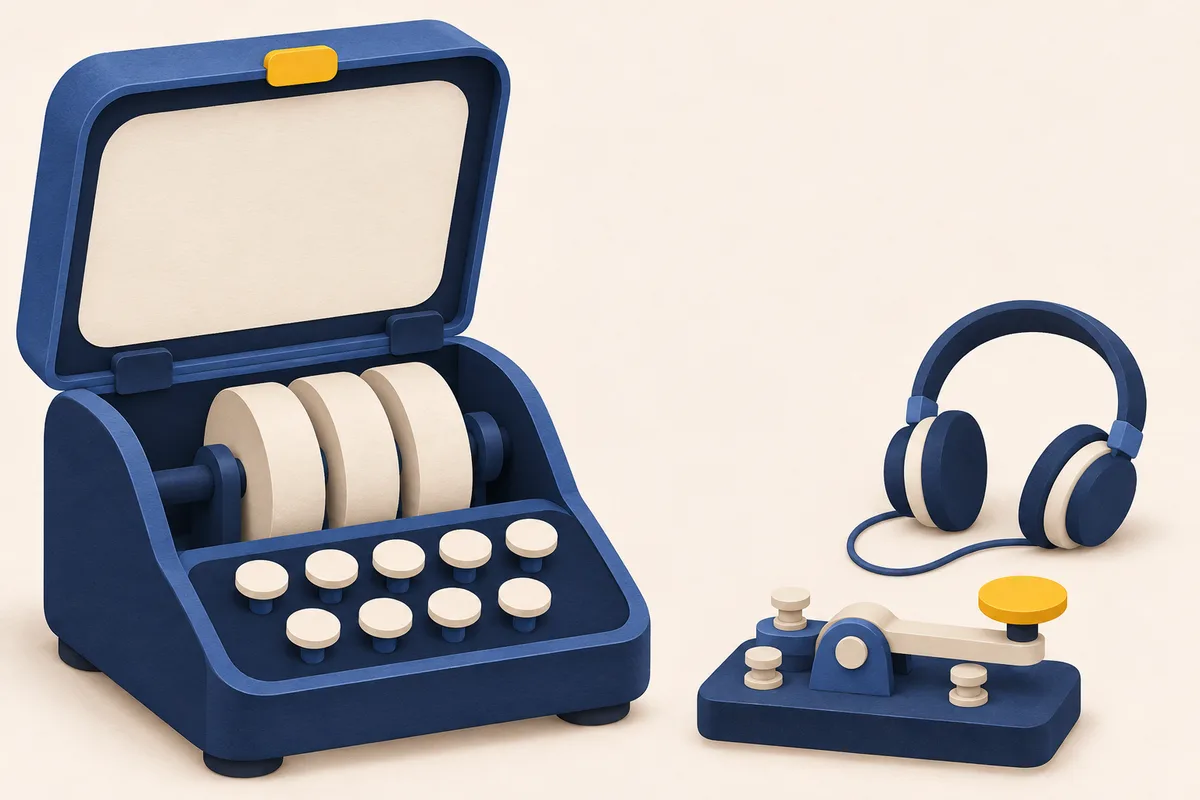
- Encipher: prepare the ciphertext with the Enigma machine and its settings (The National Museum of Computing).
- Transmit: send the ciphertext letters in Morse over radio (GCHQ).
- Copy: listen to the signals and write down the letters (GCHQ).
- Decipher: recover the readable text using the required key settings (The National Museum of Computing).
Those are distinct jobs. A successfully copied intercept could still be unreadable ciphertext (The National Museum of Computing). The guide to Morse code in World War II follows the wider signaling work.
What are two useful Enigma facts?
Enigma's substitution changed as you typed, and a letter could never encipher to itself (National Museum of Computing, wheel movement), (The National Museum of Computing). The moving wheels changed the wiring position at each keypress. You should therefore avoid explaining Enigma as one fixed replacement alphabet (National Museum of Computing, wheel movement).
The reflector arrangement prevented self-encipherment. It also made the machine reciprocal: at the same wheel position, if one letter corresponded to another, the reverse substitution also held. This supported both enciphering and deciphering, while the restriction gave codebreakers a useful clue (The National Museum of Computing).
To test the reverse substitution, reset the wheels to the same starting position before pressing the second letter (The National Museum of Computing), (The National Museum of Computing). A classroom diagram should label the starting settings rather than suggest that every keypress uses an unchanged alphabet.
Who broke Enigma before Bletchley Park?
Polish cryptanalysts had read Enigma messages before the war. GCHQ records a meeting outside Warsaw on 25 and 26 July 1939, where Polish specialists shared their work with French and British counterparts. This included their electromechanical bomba, a machine that supported codebreaking (GCHQ).
GCHQ says the shared knowledge transformed the British approach. It also records Alan Turing's later discussions with Polish mathematician Marian Rejewski in Paris in January 1940. Give this cooperation a place in your account rather than crediting the whole achievement to one person (GCHQ).
What did Turing and Welchman's Bombe do?
The British Bombe helped recover Enigma key settings. Turing's approach used a crib: text thought to occur in the message, compared with the ciphertext. Gordon Welchman's diagonal board reduced false stops, and the British Tabulating Machine Company engineered and built the machines (The National Museum of Computing).
A Bombe was different equipment from an Enigma. One helped attack the cipher; the other enciphered or deciphered messages for its users. The museum describes a working reconstruction, a checking machine and an Enigma as separate objects you can examine in its collection (The National Museum of Computing).
For a model or presentation, label these three roles: intercept operator, cryptanalyst and machine operator. Ask which stage each person contributes to. The telegraph operator guide gives another way to explore the human work behind signaling.
Hear the transmission step yourself
This player sends QXRTF, an invented practice group. It is not an authentic Enigma intercept or the output of an Enigma simulation. The signals use the International Morse letter table (ITU-R M.1677-1, Annex 1).
Write down the letters you hear, then check them against the Morse code alphabet. Enter the same group in the Morse code translator to compare your copy. For a listening lesson, use Morse practice by ear.
Now explain what your exercise established: you recovered the displayed letters. You have not recovered an underlying secret message, because this exercise supplied no encrypted original. That distinction is the question to take into a real intercept record.
Examine a machine and its evidence
Use The National Museum of Computing’s machine photographs to compare the keyboard, lampboard, plugboard and wheels. Record which military version a source shows before generalizing about every Enigma (The National Museum of Computing).
The National Museum of Computing's Bombe resource connects the reconstruction with the search for key settings. Compare it with GCHQ's account of the Pyry meeting when preparing a timeline. For a different wartime cryptanalysis case, examine the Zimmermann Telegram and its decoding.
Sources
- The Enigma Machine, Bombe History chapter 2. The National Museum of Computing, checked 11 November 2026.
- The Principle of the Enigma, Tony Sale: Codes and Ciphers. The National Museum of Computing, 19 November 2018.
- GCHQ Scarborough veteran revisits her past. GCHQ, 7 November 2014.
- The Pyry Forest Meeting. GCHQ, 21 July 2020.
- The Turing-Welchman Bombe. The National Museum of Computing, checked 11 November 2026.
- Recommendation ITU-R M.1677-1, International Morse code. ITU Radiocommunication Sector, October 2009.