
- Translator
- Civil War
Morse code in the Civil War
Yes, Morse code was used in the Civil War: the Union's Military Telegraph Corps sent it over wires from Lincoln's War Department office to the armies. Signal flags did not use it. They had their own wigwag code.
In short: Yes. The Union ran a Military Telegraph Corps that sent Morse code between the War Department in Washington and the armies in the field, and President Lincoln visited its office every day. Signal flags and torches did not use Morse. They had Myer’s own wigwag code, which began with four elements and ended the war with two.
How did the Union get a telegraph corps?
From railroad men. David Homer Bates, who wrote a memoir of the corps in 1907, printed the earliest official despatches that, as he put it, could be definitely recalled. On 22 April 1861 Andrew Carnegie wired the Pennsylvania Railroad's telegraph superintendent: “Send four of your best operators to Washington at once” (Bates, 1907). Bates, then an operator at Altoona, was one of the four. The Library of Congress says they were ordered to Washington to form a new telegraph corps within the War Department, the first time a federal department had telegraph service (Library of Congress).
Skilled operators stayed scarce. Bates wrote that it was not always easy to find enough, and that when the corps learned of enlisted or drafted men who could telegraph, it asked the Secretary of War to detail them. One of his examples is a private in a Pennsylvania artillery battery, furloughed without pay in June 1864 so that he could join (Bates, 1907). The War Department telegraph office grew to ten or twelve day operators, with two or three more at night (Bates, 1907).
What was Lincoln's telegraph office?
It was a room at the War Department, across the lawn from the White House, and Lincoln visited it daily (Library of Congress). The Executive Mansion had no telegraph in the war, so all the President's telegrams went through the War Department (Bates, 1907). Bates claimed that Lincoln spent “more of his waking hours in the War Department telegraph office” than anywhere except the White House (Bates, 1907). During the Seven Days' Battles in 1862, General McClellan sent frequent dispatches there, and the President often came to read them (Library of Congress).
One failure shows how far the wire reached. On 21 July 1861, the day of the battle of Bull Run, the line stopped at Fairfax Court House, and mounted couriers carried messages from the front to that office. Hours of encouraging reports then stopped. Bates recalls that the short sentence “Our army is retreating” came over the instrument in Morse characters (Bates, 1907).
Memory is a caution here. Bates also reports Major Eckert's recollection that Lincoln wrote the first draft of the Emancipation Proclamation at Eckert's desk in the cipher room, in June 1862 (Bates, 1907). That account comes from a memoir written decades afterward, and we found no second source for it.
How big was the corps, and what did Lincoln write there?
Bates says the Military Telegraph Corps had over fifteen hundred members at its maximum strength. He calls it a special organization whose members “were not considered an integral part of the army.” By 1907, when he wrote, fewer than two hundred of them were still alive (Bates, 1907). In the office, Lincoln used the waiting time to write. Bates recalls that “in the intervals of waiting he would write messages of inquiry, counsel and encouragement” to the generals in the field (Bates, 1907).
The railroads that supplied the first operators are the subject of Railroad telegraphers.
For where the code itself came from, see Who invented Morse code?.
How did the lines reach the front?
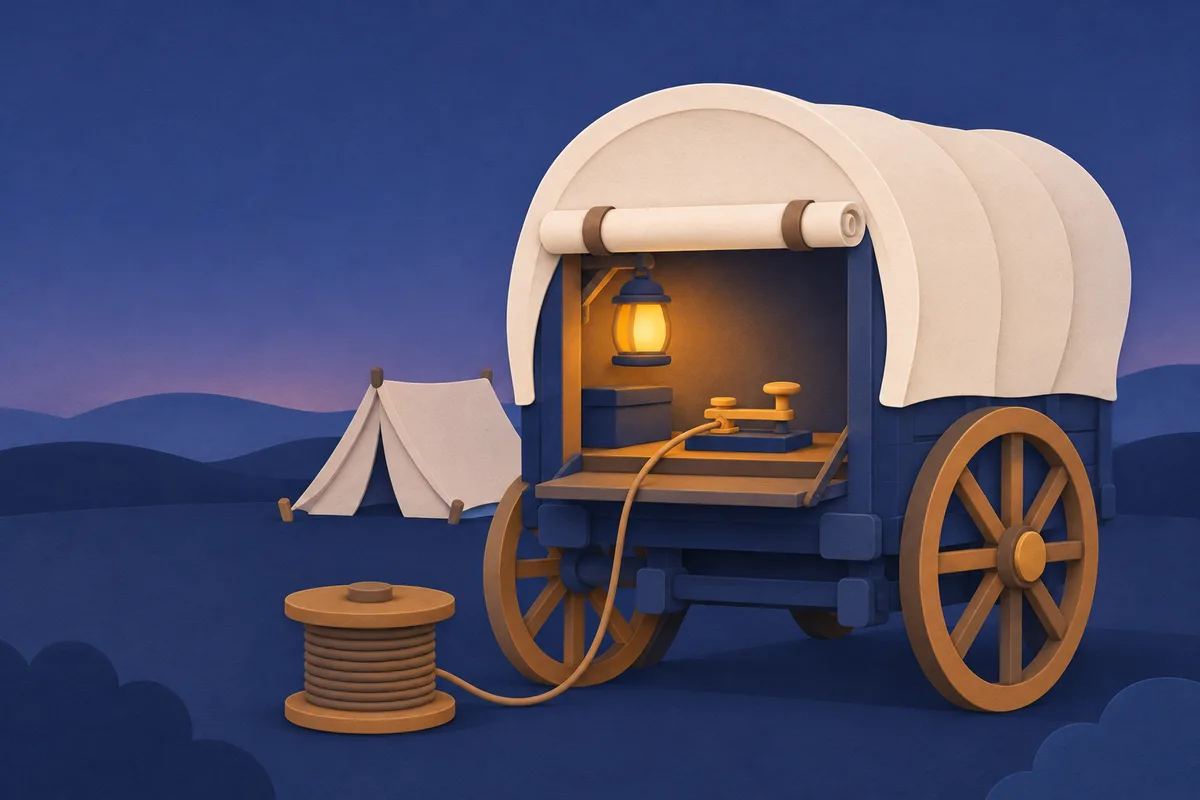
By stringing wire as fast as the armies moved. The Library of Congress notes that mobile telegraph stations and hastily strung wires began to connect scattered units as the war went on, and that in 1864 photographers recorded a field telegraph station near Charles City Court House, Virginia (Library of Congress). The National Archives holds a photograph of a field telegraph battery wagon at Petersburg in September 1864 (National Archives). Wire could also be a hazard to the enemy: at Fort Sanders in Knoxville, a Confederate assault force under General Longstreet got tangled in Union telegraph wire strung from tree stump to tree stump (Library of Congress).
Could the enemy listen in?
Yes, and operators could hear it. Bates says every Morse operator's sending is as recognizable as handwriting. In late 1862, during Burnside's Fredericksburg campaign, the War Department operators noticed strange signals on the wire to his headquarters. The intruder answered, said he was a Confederate operator from Lee's army who had been on the wire for several days, and left. Patrolling linemen later found the joint, hidden with fine silk-covered wire. In the meantime the office sent Burnside its messages backward, with words misspelled, a homemade cipher (Bates, 1907). Important dispatches also went out in cipher, and the office's cipher-operators translated them in and out (Bates, 1907).
What about flags and torches?
Flag signals are a different matter. Major Albert Myer, an Army surgeon, invented the flag-and-torch system in the 1850s and the Army adopted it in 1860 (National Park Service). It used a four-element code at first and a two-element code by the end of the war: a flag swung to the sender's left meant a 1 and to the right a 2, and letters were built from those two numerals, “as dots and dashes were used in telegraphy.” The park service believes the first use in combat was a Confederate message at Manassas, “Look out for your left; you are turned” (National Park Service). So the flags carried a code of their own, not Morse.
| Method | Code | Source |
|---|---|---|
| Telegraph wire and key | Morse code, between the War Department and the armies | Bates, 1907 |
| Field telegraph stations | Electric telegraph over wire strung behind the armies | Bates, 1907 |
| Signal flags and torches | Myer’s wigwag: four elements at first, two by the end of the war; not Morse | National Park Service |
What did the code sound like?
The wartime operators used the American version of the code, in which some letters differ from the International code you hear on this site. American vs International Morse compares them. For the machine at the other end of the wire, read How the telegraph worked, and for the people at the keys, Telegraph operators. The translator plays any message, and the alphabet lists the letters.
Sources
- David Homer Bates, Lincoln in the Telegraph Office: Recollections of the United States Military Telegraph Corps during the Civil War. The Century Co., New York; scan at the Internet Archive, 1907.
- David Homer Bates, Biographies, The Civil War in America. Library of Congress, checked 7 November 2026.
- Today in History: May 24. Library of Congress, read in the Wayback Machine copy of 2 July 2026.
- An Innovative Technology of War. National Park Service, Antietam and Manassas National Battlefields, last updated 23 August 2017.
- Before there was broadband, there was a beard (photograph ARC 533347, Field Telegraph Battery Wagon, Petersburg, September 1864). National Archives, Pieces of History blog, 1 October 2010.