
- Translator
- Sparks radio operator
Why radio operators were called Sparks
Sparks was a nickname for a ship's radio operator, apparently referring to the spark transmitters used in early wireless telegraphy (The MARE Report, shipboard radio officers). It also fits a six-letter crossword clue for that nickname.
Sparks was the ship's radio operator. The nickname refers to the spark-gap transmitters used in early wireless telegraphy (The MARE Report, shipboard radio officers). A Morse key controlled the signal, and another operator received the coded message by radio (Science Museum, 2013). If you are solving a six-letter clue for a ship's radio operator's nickname, try SPARKS and check the crossing letters (Merriam-Webster, sense 6).
Why were radio operators called Sparks?
The name described the equipment they worked with. In a spark transmitter, charged capacitors discharged across a gap, producing the radio signal. The operator used a key to shape the transmission into Morse characters. Science Museum curator John Liffen notes that operators were nicknamed Sparks “with good reason”, and then explains that early wireless transmitters made their signals with sparks (Science Museum, 2013).
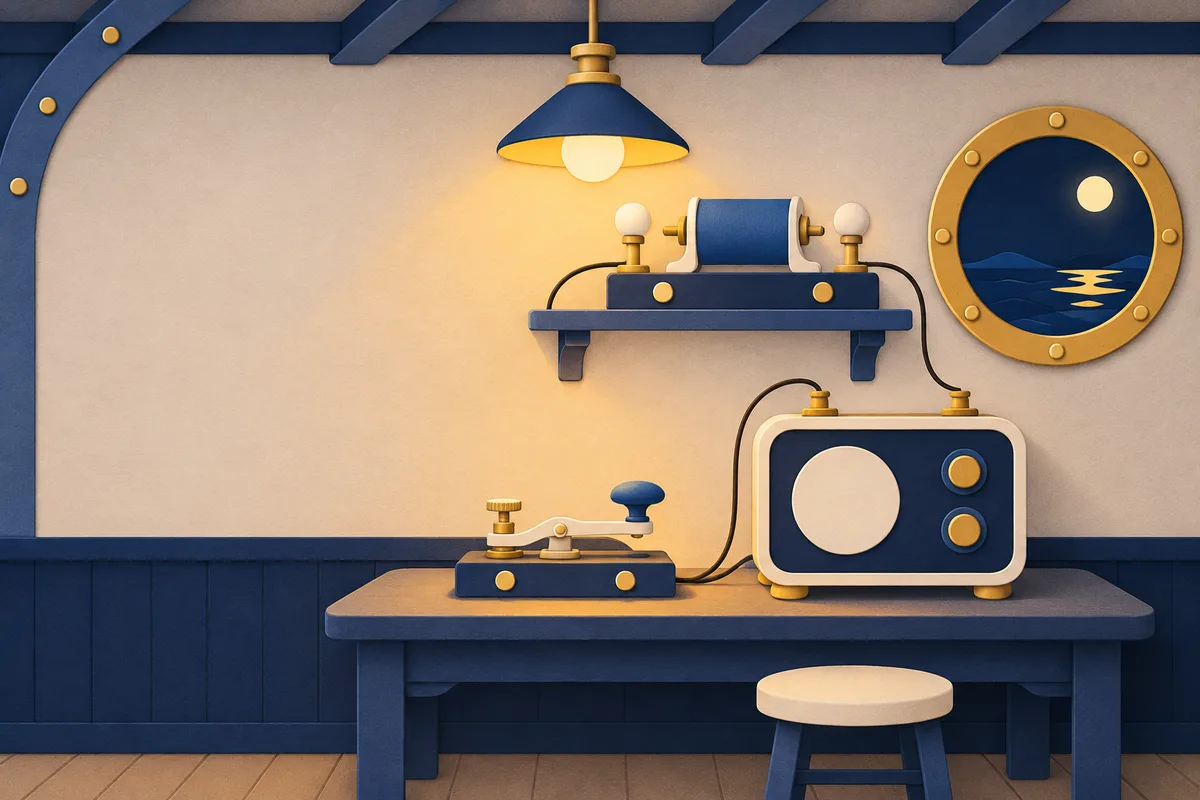
Read the word as a job nickname when it appears in a shipboard account. Merriam-Webster lists this nautical sense under spark, specifying that sparks has a plural form but refers to one person (Merriam-Webster, sense 6). You do not need to assume that several operators are being mentioned because the word ends in S.
For another name encountered in operator history, see the meaning of brass pounder.
What did the sparks have to do with Morse code?
Separate the source of the radio waves from the message they carry. Museums Victoria describes the stages of a ship's spark system: a Morse signal is keyed in, an induction coil supplies the spark, and coils and a capacitor form part of the tuned transmitting apparatus (Museums Victoria, transmission process).
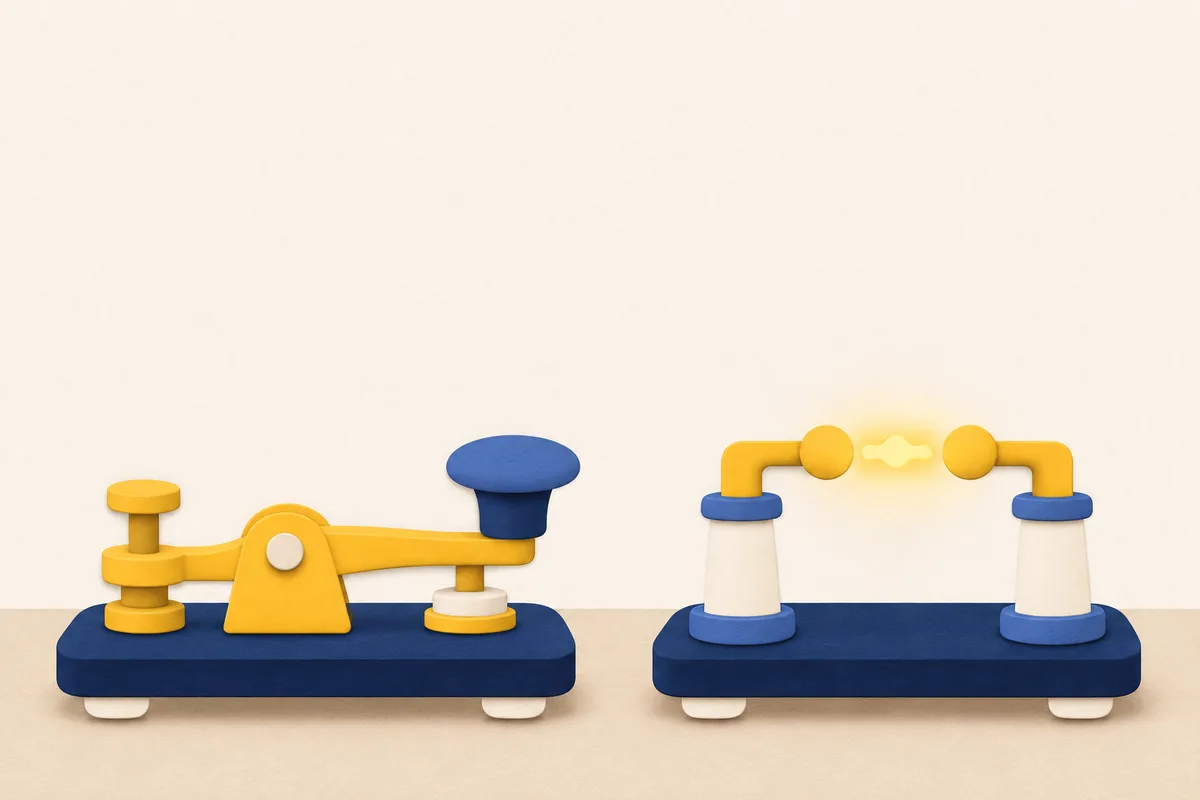
The key was the operator's control; the spark gap was part of the transmitter. In the Science Museum's modern recreation, the Morse signals were heard as a harsh buzzing (Science Museum, 2013). He also identifies spark transmission as the method used by Titanic's operators Jack Phillips and Harold Bride in April 1912 (Science Museum, 2013). The nickname describes this technology, rather than a special alphabet called “Sparks code.”
The separate guide to Morse code keys explains the operator's sending controls.
What is a ship radio operator?
In David Reid's account of merchant-ship communications, the radio officer handled messages between ship and shore. A shore station announced the call signs of ships with messages waiting. The operator listened for the ship's call sign, established contact, received the message and made a written copy for the captain (The MARE Report, Morse and Marconi).
Reid describes waiting for a turn on a busy traffic list and dealing with fading reception. His account also includes weather messages and personal news for crew members. This gives you a more useful picture of the work than imagining that the operator spent every watch sending distress calls (The MARE Report, shipboard communications).
For the broader occupation beyond a ship's radio room, read about telegraph operators and their work.
For a separate message-handling system, explore radiograms and the National Traffic System.
Did the nickname outlast spark transmitters?
Yes. Royal Museums Greenwich catalogs a photograph of Ralph Collins aboard the refrigerated cargo ship Maranga, identifying him as the radio or electrical officer known as Sparks. The record dates the photograph to September–November 1974 (Royal Museums Greenwich, PCT15978).
That gives you a specific, dated example of the name in use. It does not establish what transmitter Collins used. Avoid dating a radio installation from the nickname alone: the catalog supplies evidence about the person and photograph, while an equipment claim would need its own record.
The technology had changed much earlier. Museums Victoria explains how valves, also called tubes, developed during 1914–1920. Transmitting valves could generate continuous radio-frequency waves, improving on the decaying wave trains of spark transmitters. Receiver amplification also improved sensitivity (Museums Victoria, Radio from sparks to valves).
You can inspect the Greenwich collection record for Collins for its date and description, then use the Museums Victoria component collection to compare the equipment categories. Keep the photograph's date separate from the dates attached to individual components.
Ship's radio operator crossword clue: is it SPARKS?
SPARKS fits six squares when the clue asks for the nickname. Its meaning is supported by the dictionary's nautical definition (Merriam-Webster, sense 6). For a particular puzzle, the grid and crossing letters still decide whether that answer fits.
Does Sparks describe today's marine radio work?
Use the nickname with its historical context. IMO dates full implementation of the Global Maritime Distress and Safety System, or GMDSS, to 1 February 1999. It describes an integrated system using satellite and terrestrial radio communications (IMO, Radiocommunications).
IMO's page sets out equipment requirements for passenger ships and cargo ships above 300 gross tonnage on international voyages. For current marine-radio study, use that official overview of GMDSS as a starting point (IMO, SOLAS chapter IV). A historical nickname by itself tells you nothing about the certificate required for a job you are considering.
Hear SPARKS as a Morse practice word
The player spells SPARKS using International Morse. It is a modern learning aid, not a recording of a spark transmitter. S is ; P is . The full word's letter patterns follow the ITU alphabet (ITU-R M.1677-1, Annex 1).
Try copying the six letters before checking them against the Morse alphabet chart. Use the Morse code translator for another ordinary word. If recognizing whole character rhythms is your goal, start with Morse lessons by ear and return to this word after practicing its letters individually.
Sources
- Sparks Fly In West London, John Liffen. Science Museum, 3 December 2013.
- Spark, noun (1), sense 6. Merriam-Webster, checked 10 November 2026.
- Radio from sparks to valves, 1914–1920, Michael R. Osborne. Museums Victoria, checked 10 November 2026.
- Morse and Marconi: Connecting with Seafarers, David Reid. The MARE Report, North American Maritime Ministry Association, checked 10 November 2026.
- Ralph Collins, known as Sparks, in the radio room aboard Maranga; PCT15978. Royal Museums Greenwich, checked 10 November 2026.
- Radiocommunications. International Maritime Organization, checked 10 November 2026.
- Recommendation ITU-R M.1677-1, International Morse code. ITU Radiocommunication Sector, October 2009.