
- Translator
- Vibroplex bugs
Vibroplex bug keys
A Vibroplex bug is a semi-automatic Morse key that makes repeated dots mechanically while you make the dashes by hand. Its pendulum weight controls the dot speed (French, pp. 41–42).
A Vibroplex bug is a mechanical, semi-automatic Morse key: a vibrating weighted arm makes repeated dots, while you time each dash. Moving the weight changes the dot speed. You still choose how many dots to send and where the letters end (French, pp. 8–9, 41–42). Start by identifying your model before changing its adjustments.
How does a Vibroplex semi-automatic bug key work?
On the mechanical Vibroplex design, moving the lever for dots starts a horizontal pendulum vibrating. Its contact repeatedly makes and breaks the circuit. The dash movement closes a separate contact for as long as you hold it. When you return the lever to rest, the damper brings the pendulum to a stop (French, p. 42, Martin patent 842,154). “Semi-automatic” describes that division of work.
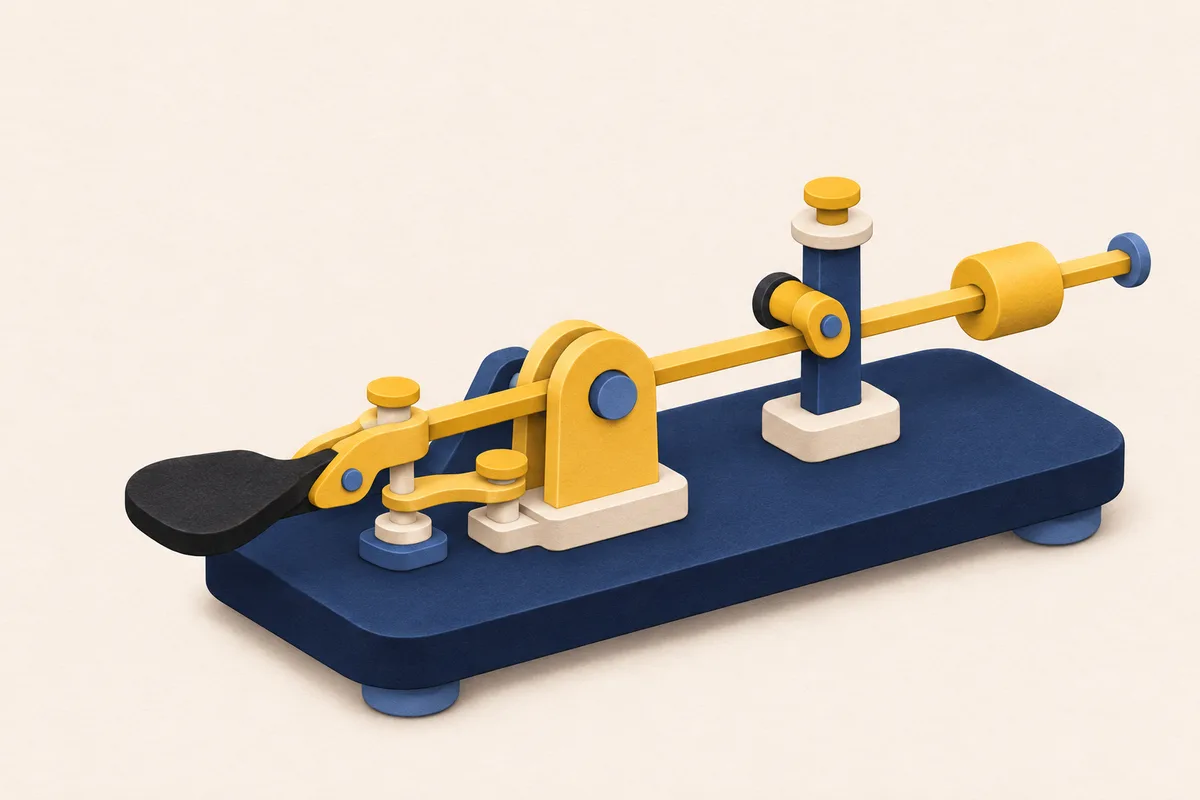
Watch the contact and the pendulum separately during a practice session. Ask yourself whether you are checking dot repetition, dash length or the transition between them. Give each a separate test before attempting a full word.
The name is also a brand. Vibroplex says its first Morse keys went on sale in 1905 (Vibroplex, checked 10 November 2026). French's collector history describes Horace G. Martin's introduction of the mechanical Vibroplex in that year, following his electromechanical Autoplex (French, pp. 19 and 37). For the wider operator context, explore brass pounders and their tools.
For the individual rhythm of hand sending, see the guide to an operator's fist.
Is your Vibroplex a bug, a paddle or a straight key?
Do not identify the mechanism from the insect logo alone. The manufacturer's documentation distinguishes Original and Blue Racer bugs, Vibrokeyer single-lever paddles, iambic paddles and straight keys (Vibroplex, technical data). Look for the actual model before choosing instructions.
A paddle used with electronic timing can repeat both short and long elements. A straight key leaves both durations to your hand (ARRL On the Air, January/February 2022). If you need that comparison, use the guide to keys, paddles and keyers. Here, keep your inspection focused on the bug's pendulum, weight, damper and two contact actions.
Photograph the top, both sides and the nameplate. Write the wording exactly, including the address and any letter before the serial number. Keep that record with your adjustment notes. It gives you a consistent starting point when comparing the key with drawings or asking about a missing part.
Vibroplex serial numbers: how old is your bug?
Use John Elwood's dating chart for an approximate year. Elwood explains that the dates draw on advertisements, patents, sales slips, addresses and owner reports, with some dates extrapolated. Early keys used separate number blocks (Elwood, 1996, p. 1). Treat the chart as historical evidence with limits.
- Copy the complete number. Keep prefixes and leading zeros in your notes.
- Find the relevant range. For example, Elwood places serial numbers 210,518 through 217,034 in approximately 1960 (Elwood, p. 3).
- Compare the nameplate. Use its address alongside the number; do not discard an apparent mismatch.
- Check the later addendum. The chart stops in the mid-1990s. Vibroplex's documentation adds the Mobile and Knoxville numbering changes, including Knoxville numbers from 400000 upward starting in late 2010 (Vibroplex, How old is my key?).
Vibroplex explicitly says the serial number indicates manufacture date rather than model (Vibroplex, dating notes). Keep two separate entries in your record: estimated year and model identification. Avoid turning a chart match into a claim that every fitted component is original. If your evidence disagrees, retain the uncertainty when describing the key.
What do Vibroplex bug weights change?
Sliding the pendulum weight changes dot repetition speed (French, p. 42, Martin patent 842,154). That changes the mechanical dots. Your dash duration remains your responsibility. Mark your starting position in a photograph before moving anything, then compare a short dot group before and after.
Do not try to match a faster dot stream by shortening only some dashes. Murphy's adjustment article warns against setting dots too fast and varying speed through dashes alone (Murphy, Operating). Choose a comfortable setting, then assess the whole rhythm. Leave improvised extra weights off your first troubleshooting attempt; establish what the existing mechanism does before changing its parts.
Vibroplex bug adjustment: what should you check first?
Open the manufacturer's matching drawing and adjustment sheet beside the key. Murphy's procedure begins with the stops and damper, checks that the returning arm does not bounce, and then addresses travel and dot-contact alignment. A travel change can require resetting the dot contact (Murphy, Procedure). Follow that order rather than turning every screw at once.
For your first session, set a narrow goal: get a clean short group of dots, then test a dash, then alternate them. Record one adjustment at a time and return to the starting setting if the result becomes harder to judge. Compare what you hear with the same practice characters each time.
Murphy also calls for secure mounting and warns against sandpaper or emery paper on contacts because of residue and wear (Murphy, p. 2). Stop a cleaning attempt if you cannot identify the contact or finish. A repair question with clear photographs is more useful than a description after several unrecorded alterations.
For the separate history of occupational strain, read glass arm and the telegrapher's cramp.
Practice dots, dashes and the change between them
Use S, O and A as a small comparison set. In International Morse, S is , O is , and A is . A dash lasts three dot units, and the gap between elements in one character lasts one (ITU-R M.1677-1, Annex 1). Those patterns let you separate a dot group, manual dashes and a transition.
Use Morse code timing to compare signal lengths and pauses.
Try S alone, pause, then try O. Finish with A and listen to the join between its short and long elements. Keep the same test after an adjustment so you can compare it fairly. Use the International Morse alphabet chart to choose another letter, the Morse code translator to hear it, and practice by ear for a listening routine.
For the receiving instrument's separate role, see how a telegraph sounder turns circuit changes into clicks.
Vibroplex bugs for sale, parts and cables: what to verify
Before buying a bug on eBay or elsewhere, ask for your identification photographs and a demonstration of both actions. State whether you want a working practice key or a collection piece. Compare its visible parts with the model drawing before accepting a seller's description of completeness.
For replacement parts, Vibroplex directs you to the model's machine drawing and four-digit parts list. Its service page lists support for current-production models built from 1945 onward and says pre-1945 parts are unavailable (Vibroplex, parts and service, checked 10 November 2026). Check that page again before ordering.
For a bug cable, begin with the receiving equipment's manual. Write down its connector, accepted key type and wiring requirements before choosing a lead. Do not choose by plug appearance alone. If you cannot confirm those details, ask the equipment maker with the exact model name; leave the key disconnected until you have the matching instructions.
Sources
- Vibroplex Morse code keys. Vibroplex, checked 10 November 2026.
- Vibroplex Collector's Guide, Tom French, W1IMQ, third edition. Tom French; hosted by Vibroplex, checked 10 November 2026.
- Birth Dates of the Vibroplex Keys, John Elwood, WW7P. John Elwood; hosted by Vibroplex, 1996.
- Semi-Automatic Key Adjustment, Brian Murphy, VE2AGO. QST; hosted by Vibroplex, checked 10 November 2026.
- Repair, parts and documentation: adjustments, drawings and dating addendum. Vibroplex, checked 10 November 2026.
- Key Pieces and Paddle Parts; Tools for Sending Code, Steve McGrane, KM9G. ARRL, On the Air magazine, January/February 2022.
- Recommendation ITU-R M.1677-1, International Morse code. ITU Radiocommunication Sector, October 2009.