
- Translator
- Timing
Morse code timing
In Morse code the silences carry as much as the signals: a listener knows a letter has ended, or a word, only because the pause grew. Everything is counted in units of one dot, and the speed you send at decides how many milliseconds a unit lasts.
In short, at 20 words per minute, where one unit is 60 ms:
- dot: 1 unit, 60 ms; dash: 3 units, 180 ms;
- gap between the signals of one letter: 1 unit, 60 ms;
- gap between letters: 3 units, 180 ms;
- gap between words: 7 units, 420 ms.
How long is a unit in milliseconds?
ITU-R M.1677-1 gives ratios and no durations (ITU-R M.1677-1), so the speed has to decide how long a dot lasts. ARRL's timing standard gives one unit as 1.2 ÷ WPM seconds, which is 1200 ÷ WPM milliseconds (ARRL, QEX, April 1990). Here is what that formula gives at common speeds:
| Speed | Dot, and gap inside a letter (1 unit) | Dash, and gap between letters (3 units) | Gap between words (7 units) |
|---|---|---|---|
| 5 WPM | 240 ms | 720 ms | 1,680 ms |
| 10 WPM | 120 ms | 360 ms | 840 ms |
| 13 WPM | 92 ms | 277 ms | 646 ms |
| 15 WPM | 80 ms | 240 ms | 560 ms |
| 18 WPM | 67 ms | 200 ms | 467 ms |
| 20 WPM | 60 ms | 180 ms | 420 ms |
| 25 WPM | 48 ms | 144 ms | 336 ms |
| 30 WPM | 40 ms | 120 ms | 280 ms |
| 40 WPM | 30 ms | 90 ms | 210 ms |
A dash and the gap between letters last the same three units, and so do a dot and the gap inside a letter. To check a speed by hand, divide 1200 by it: at 12 WPM a dot is 100 ms, so a dash is 300 ms and a word gap 700 ms.
Calculate the timing at your speed
Set the speed of the letters, and optionally a slower overall speed for Farnsworth timing, or give the length of a dot in milliseconds. Type a message to see how long it lasts, drawn to scale.
Everything runs in this browser. Nothing you type is uploaded or sent anywhere, and sound starts only when you press Listen.
This calculator needs JavaScript. Without it, use the table above, or divide 1200 by the speed in words per minute for the length of a dot in milliseconds.
| Element | Dot units | Milliseconds |
|---|---|---|
| Dot | ||
| Dash | ||
| Gap inside a letter | ||
| Gap between letters | ||
| Gap between words |
Your message
- Solid bar: a dot or a dash
- Outlined bar: gap between letters
- Hatched bar: gap between words
The calculator shows perfectly even timing as the standard and ARRL's Farnsworth rule define it; a person keying by hand will not match it exactly. It does not measure your speed, and it times letters, digits and punctuation that have a code, up to 300 characters; any other character is skipped and listed.
How a listener knows a letter has ended
Only by the silence. Nothing in the sound marks the end of a letter: when the pause after a signal grows from one unit to three, the letter is over. If that gap shrinks to one unit, the gap that sits inside every letter, some pairs of letters merge into other, valid letters instead of noise (ITU-R M.1677-1, 2.2). Of the 676 possible pairs of letters, 56 turn into a different single letter when the gap between them shrinks to that one unit:
| Sent as | With the letter gap | Without it | Heard as |
|---|---|---|---|
| E then T | A | ||
| T then E | N | ||
| E then E | I | ||
| T then T | M | ||
| A then N | P | ||
| M then E | G |
Whole words can collapse the same way. Hear the word TEN with proper gaps, then the same signals with the letter gaps reduced to one unit:
The opposite mistake splits letters. Leave a three-unit pause in the middle of A, and a listener hears E and then T. ARRL's guide for sending messages by Morse calls spacing between groups crucial and warns that copy degrades quickly when letters run together (ARRL, NTS guidelines).
Counting a word unit by unit
To time any word, add up its signals, the gaps inside each letter, the gaps between letters and the gap after the word. Here is CODE:
| Letter | Code | Sound | Gaps inside | Units |
|---|---|---|---|---|
| C | 8 | 3 | 11 | |
| O | 9 | 2 | 11 | |
| D | 5 | 2 | 7 | |
| E | 1 | 0 | 1 | |
| 3 gaps between letters, 3 units each | 9 | |||
| Gap after the word | 7 | |||
| Total | 46 | |||
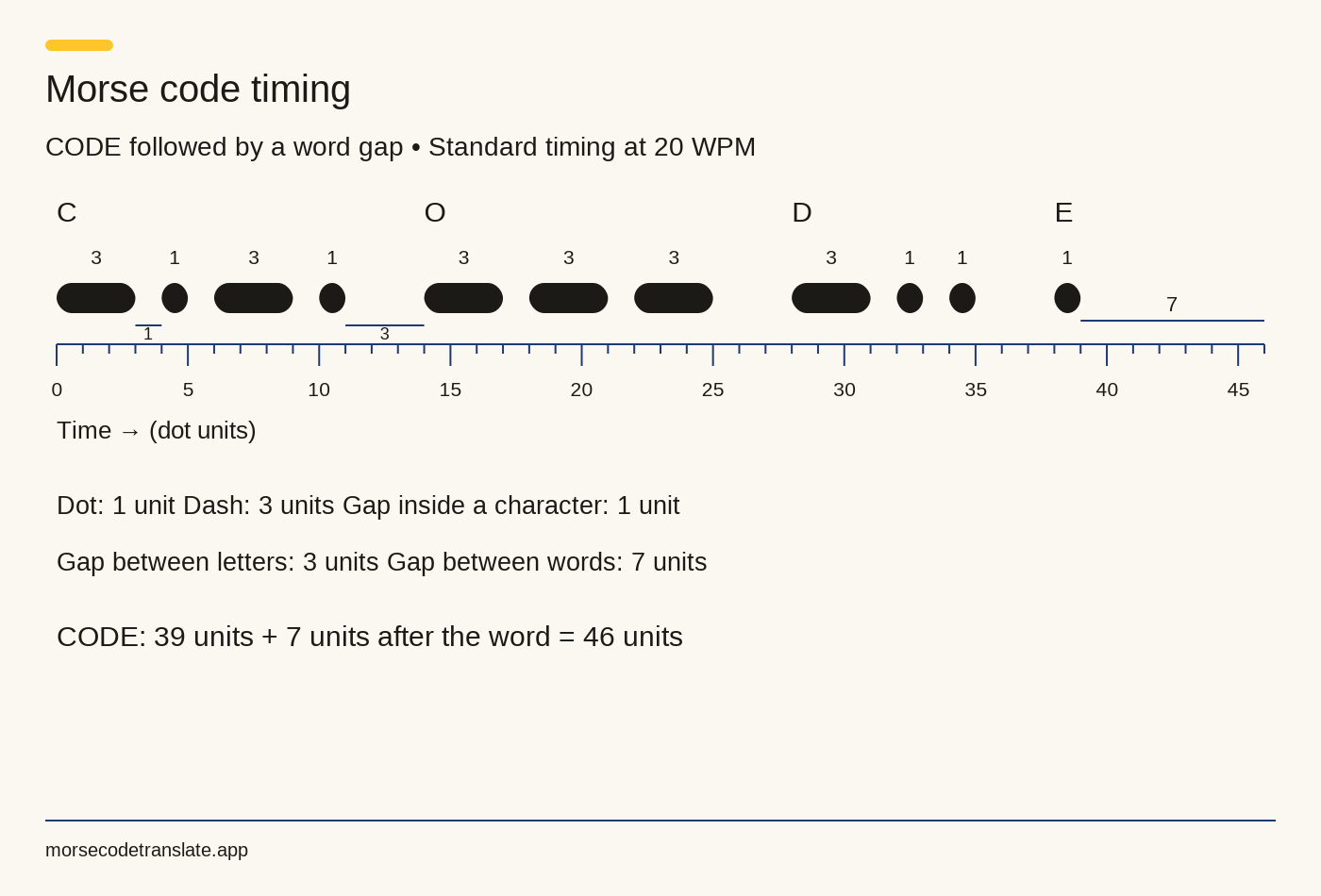
Open the chart to print or save it
At 20 WPM that is 46 × 60 ms = 2.76 seconds. Speeds are measured with a word counted in exactly this way, PARIS, which comes to 50 units; Morse code speed (WPM) explains why that word was chosen.
When only the gaps are stretched
Farnsworth timing keeps the letters at their fast rhythm and stretches only the silences between them. ARRL's 1990 standard used it below 18 WPM, with letters sent at 18 WPM; today ARRL's code practice files send speeds of 15 WPM and below with a 15 WPM character speed and use standard timing from 18 WPM up (ARRL code practice files). The 1990 standard adds the extra time so that the gap between words stays 7/3 of the gap between letters, the same proportion as standard timing (ARRL, QEX, April 1990). With letters at 20 WPM and an overall speed of 10 WPM, a dot still lasts 60 ms, but the gap between letters grows from 180 ms to 654 ms, and the gap between words from 420 ms to 1,525 ms.
The learning guide shows these gaps for letters at 18 WPM and explains why they help; the Farnsworth method guide goes into the method itself.
How fast is Morse code sent?
There is no single speed. The standard fixes only the ratios, so the sender picks the pace. The practice material shows the usual range: ARRL's code practice files run from 5 to 40 words per minute (ARRL, Code Practice Files), and station W1AW sends slow practice at 5, 7½, 10, 13 and 15 words per minute, fast practice at speeds up to 35, and its code bulletins at 18 (ARRL, W1AW operating schedule). Because both give a range and not one typical speed, treat any single "average Morse code speed" with care.
A word of 50 units, such as PARIS, takes 12 seconds at 5 WPM and 3 seconds at 20 WPM. Hear one PARIS at each speed:
Sending speed is how fast the characters are keyed. How quickly a signal crosses a wire is a separate question; How fast was the telegraph? covers it. To measure your own copying speed, try Morse code speed test.
Common timing mistakes
- Short dashes. A dash that is barely longer than a dot leaves the listener guessing. Make it a clear three dots long.
- Rushed letter gaps. The letters merge into others, as in the table above. When you are unsure, leave a little more space, not less.
- Pauses inside a letter. Hesitating in the middle of a letter splits it in two.
- Word gaps that match letter gaps. Words run together, and the listener has to guess where each one ends.
The translator plays any text at speeds from 5 to 30 WPM, so you can listen along. From 18 WPM up it uses standard timing; below that it keeps the letters at 18 WPM and stretches the gaps, as described above. When you write Morse down, a space and a slash stand in for the gaps: How to write Morse code shows how.
The Morse code alphabet draws every letter to the same scale, and SOS in Morse code shows the timing of one signal sent as a single character.
Sources
- Recommendation ITU-R M.1677-1, International Morse code. ITU Radiocommunication Sector, October 2009.
- A Standard for Morse Timing Using the Farnsworth Technique, Jon Bloom, KE3Z. ARRL, QEX, April 1990.
- Code Practice Files. ARRL, checked 6 November 2026.
- NTS Methods and Practices Guidelines, Chapter 3: Transmitting Messages on CW. ARRL Public Service Communications Manual, Appendix B, version 3.01, May 2002.
- W1AW Operating Schedule. ARRL, the National Association for Amateur Radio, updated 9 March 2026, checked 6 November 2026.