
- Translator
- Morse code logic
Is there any logic to Morse code?
Morse code partly follows letter frequency, with short codes for common letters such as E and T. O was short in American Morse and became long in International Morse.
In short. Partly. Common letters such as E and T have short codes, but frequency does not explain every letter. O was short in American Morse and became a longer pattern in International Morse. The modern alphabet carries that history (Cornell), (Vail, 1845, p. 168), (Pope, 1872, §§156–157), (ITU, Annex 1).
Do common letters get shorter codes?
There is a useful pattern. E has a single dot, , and T a single dash, . They are the two most frequent letters in Cornell's sample. E takes 1 time unit and T takes 3, measured from the start of the first signal to the end of the last (Cornell frequency table). The letter patterns and timing proportions follow the international standard (ITU-R M.1677-1, Annex 1).
A unit is the length of one dot. A dash lasts three units, and each gap inside a letter lasts one. Count both the signals and those internal gaps when comparing letters. The Morse code alphabet lets you check each pattern against its letter.
O shows why the pattern needs qualification. In this sample it ranks fourth, at 7.68 percent, yet its three dashes take 11 units. N occurs less often, at 6.95 percent, and takes 5 units. The table below compares all the letters (Cornell), (ITU).
O had a shorter form in the original American code. Vail's 1845 list gives O three motions, the same as N. In the American alphabet, O was two dots separated by a longer internal gap (Vail, 1845, p. 168), (Pope, 1872, §§156–157, p. 101). International Morse uses three dashes for O, , making it 11 units long (ITU, Annex 1, sections 1–2). The old short O became a long letter when the code changed.
Compare every letter's frequency and duration
The duration column includes the signals and internal gaps, ending at the last signal. It excludes the pause after the letter. The frequencies are percentages from Cornell's sample of 40,000 words (Cornell). The letter patterns and unit ratios follow (ITU, Annex 1, sections 1–2).
Select a letter on the chart to see its frequency and duration.
Letter frequency and Morse duration
- Common and short
- Common but long
- Other letters
Select a letter for its frequency and duration.
Choose an order to rearrange the table.
| Letter | Code | Units | Frequency |
|---|---|---|---|
| A | 5 | 8.12% | |
| B | 9 | 1.49% | |
| C | 11 | 2.71% | |
| D | 7 | 4.32% | |
| E | 1 | 12.02% | |
| F | 9 | 2.30% | |
| G | 9 | 2.03% | |
| H | 7 | 5.92% | |
| I | 3 | 7.31% | |
| J | 13 | 0.10% | |
| K | 9 | 0.69% | |
| L | 9 | 3.98% | |
| M | 7 | 2.61% | |
| N | 5 | 6.95% | |
| O | 11 | 7.68% | |
| P | 11 | 1.82% | |
| Q | 13 | 0.11% | |
| R | 7 | 6.02% | |
| S | 5 | 6.28% | |
| T | 3 | 9.10% | |
| U | 7 | 2.88% | |
| V | 9 | 1.11% | |
| W | 9 | 2.09% | |
| X | 11 | 0.17% | |
| Y | 13 | 2.11% | |
| Z | 11 | 0.07% |
Try comparing letters with equal numbers of marks. H and J each have 4 signals. H takes 7 units, while J takes 13. The difference is 6 units because J contains more dashes. Counting marks alone misses that difference. These values are calculated from the same standard (ITU).
Now compare O with M. O appears 3 times as often in this sample, after rounding the ratio, but lasts 4 units longer. More common does not always mean shorter. E and T fit the short-code pattern, while O and M show its limits (Cornell), (ITU).
Did Vail count letters in a printer's type case?
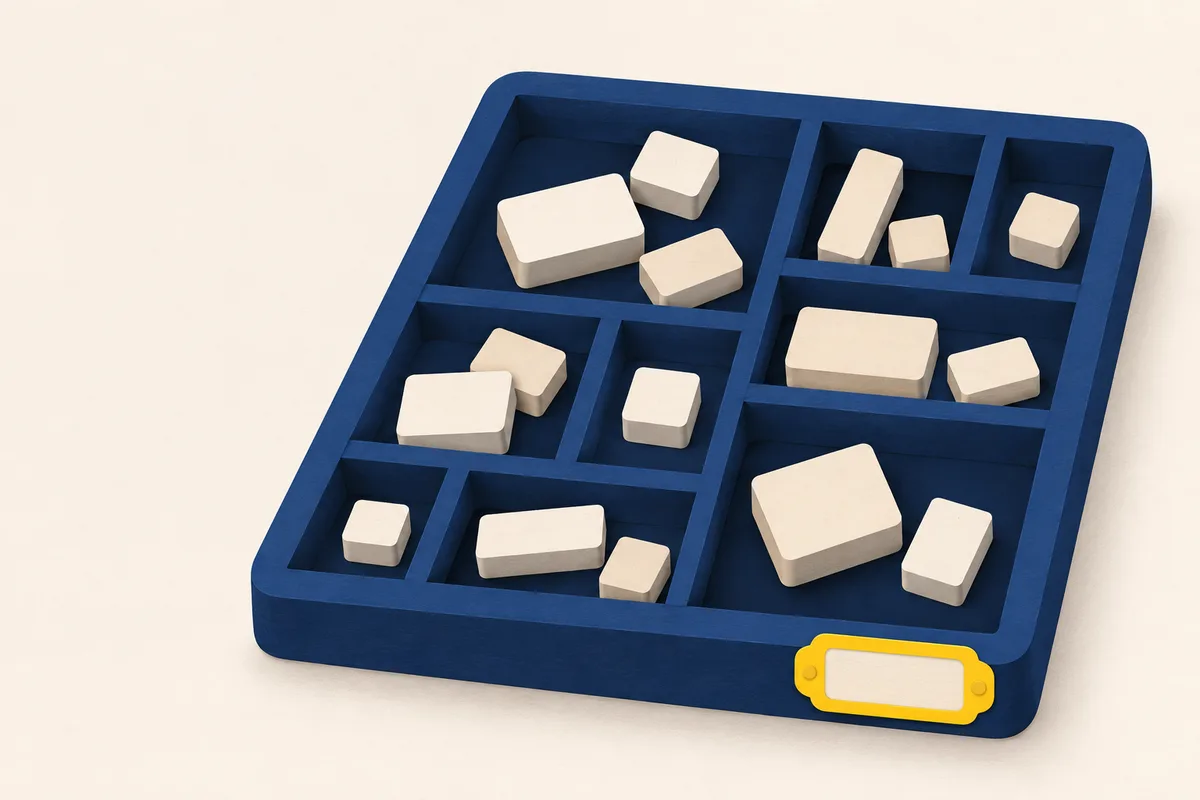
The earliest version we found is William Baxter's recollection, published by Franklin Leonard Pope in The Century in April 1888. Baxter describes Vail working out letter frequencies, then visiting a Morristown newspaper office and finding the answer in the compositor's type cases. He presents shorter combinations for common letters as Vail's plan (Pope, 1888, p. 934).
That is retrospective testimony. The article places the work in 1837, about half a century before publication. Baxter was recalling the events many years later (Pope, pp. 933–934).
Vail was already using printer-type quantities in calculations in his 1845 book. He lists quantities for a printer's case and uses them to compare the work of telegraph systems. It assigns E a quantity of 120 and Z a quantity of 2 (Vail, 1845, pp. 168–169).
Vail's calculation values T at two motions, while today's International Morse dash lasts three dot units. The two measurements use different definitions (Vail, p. 168), (ITU, section 2.1). See American vs International Morse for the code differences.
Why is it called Morse code?
The name refers to Samuel F. B. Morse. Credit for the alphabet remains disputed. Vail's 1845 book attributes its origin to Professor Morse aboard the Sully, while Baxter's later account credits Vail. Historian William B. Ashworth Jr. at the Linda Hall Library finds no evidence that establishes Vail as the alphabet's inventor (Vail, p. 30), (Pope, p. 934), (Linda Hall Library).
Who invented Morse code? examines the partnership and the competing claims in more detail.
Is Morse code a Huffman code?
No. Don H. Johnson's chapter from Rice University says Huffman showed that his code had the prefix property: “No code for a symbol began another symbol's code” (Johnson, Rice University). Morse code's dot-and-dash letter patterns do not have it on their own. 24 of the 26 letters begin with the complete code of another letter. E, a single dot, begins 12 of them, among them I, S and H (ITU, Annex 1, letter table). The same text says Morse code was not a prefix code, so the telegrapher had to insert a pause between letters, and the space counts as another code symbol (Johnson, Rice University).
That pause is the three-unit letter gap, and it does the work a prefix property would do. Without it, could be S, three Es, or I and E in either order (ITU, Annex 1, §§1.1.1 and 2). The Morse code tree draws the letters as a tree, and Morse code vs binary compares dot-and-dash notation with binary representations that preserve timing.
Is there a pattern in the digits?
Yes. Every digit has five signals. The digits 1 to 5 use that many dots followed by enough dashes to make five signals: 1 is , 2 is and 5 is . The digits 6 to 9 start with dashes, one more each time, and finish with dots: 6 is and 9 is . Zero is five dashes, (ITU-R M.1677-1, Annex 1, section 1.1.2). Once you know the rule, you can rebuild any digit instead of memorizing ten patterns. Morse code numbers lists them with sound.
Is Morse code just letters?
The International Morse standard also provides digits, punctuation and operational signs, including an error signal and an end-of-work signal. It organizes these in separate parts of its signal table (ITU, Annex 1, sections 1.1.1–1.1.3). For a broader introduction, read what Morse code is.
Use the duration table as a comparison exercise. Choose two letters, estimate their lengths using the dot as your unit, and then check the result. Enter them separately in the translator to compare their rhythms. If your next step is recognizing letters as they arrive, follow the lessons on learning by ear.
Sources
- Recommendation ITU-R M.1677-1, International Morse code. ITU Radiocommunication Sector, October 2009.
- English Letter Frequency (based on a sample of 40,000 words). Cornell University, Math Explorer's Club, checked 9 November 2026.
- The American Electro Magnetic Telegraph, pages 30 and 168–169. Alfred Vail, Lea & Blanchard; transcription at Project Gutenberg, 1845.
- Frank L. Pope, Modern Practice of the Electric Telegraph: A Handbook for Electricians and Operators, tenth edition. D. Van Nostrand, New York; scan at the Internet Archive, copyright 1872.
- The American Inventors of the Telegraph, page 934. Franklin Leonard Pope, The Century Illustrated Monthly Magazine; scan OCR at Internet Archive, April 1888.
- Scientist of the Day: Alfred Vail, by William B. Ashworth, Jr.. Linda Hall Library, checked 6 November 2026.
- Fundamentals of Electrical Engineering I, section 6.23: Subtleties of Coding, page 222, Don H. Johnson. Rice University, checked 20 November 2026.