
- Translator
- Numbers
Morse code numbers 0 to 9
Every Morse code number from 0 to 9 is exactly five signals long. The digits 1 to 5 begin with as many dots as the number itself, and 6 to 0 repeat those five patterns with every dot and dash swapped: 1 is , and 6 is .
In short:
- Every digit has exactly five signals.
- From 1 to 5, count the dots: has three, so it is 3.
- From 6 to 0, count the dashes and add five: has three dashes, so it is 8. Five dashes make 0, in the place where 10 would be.
- A longer number is sent one digit at a time.
Numbers ↔ Morse code converter
Turn numbers into Morse, or paste Morse to identify digits and letters. Everything runs in your browser; nothing you enter is uploaded, and sound starts only when you press Listen.
Enable JavaScript to use the converter, or use the digit chart and cut-number table below.
Use digits, spaces, dashes and slashes. Dashes and slashes are sent as punctuation; spaces become word gaps.
These abbreviations match the ARRL examples: 0 → T ; 1 → A ; 9 → N .
The same group can mean a letter or a cut digit because operators use the letter as a number abbreviation when the exchange calls for a number (ARRL).
Up to 500 characters. This tool reads typed Morse, not audio; keep a space between character groups and use a slash between words. Cut mode uses only the three abbreviations above and cannot infer the sender’s context.
All ten digits
Tap a digit to hear it. The words under each code are its rhythm said aloud: 7 is dah-dah-di-di-dit, a long start that falls into short beats. The ITU calls digits “figures” and lists them in the same table as the letters (ITU-R M.1677-1).
Every digit on its own page
- 1 in Morse code
- 2 in Morse code
- 3 in Morse code
- 4 in Morse code
- 5 in Morse code
- 6 in Morse code
- 7 in Morse code
- 8 in Morse code
- 9 in Morse code
- 0 in Morse code
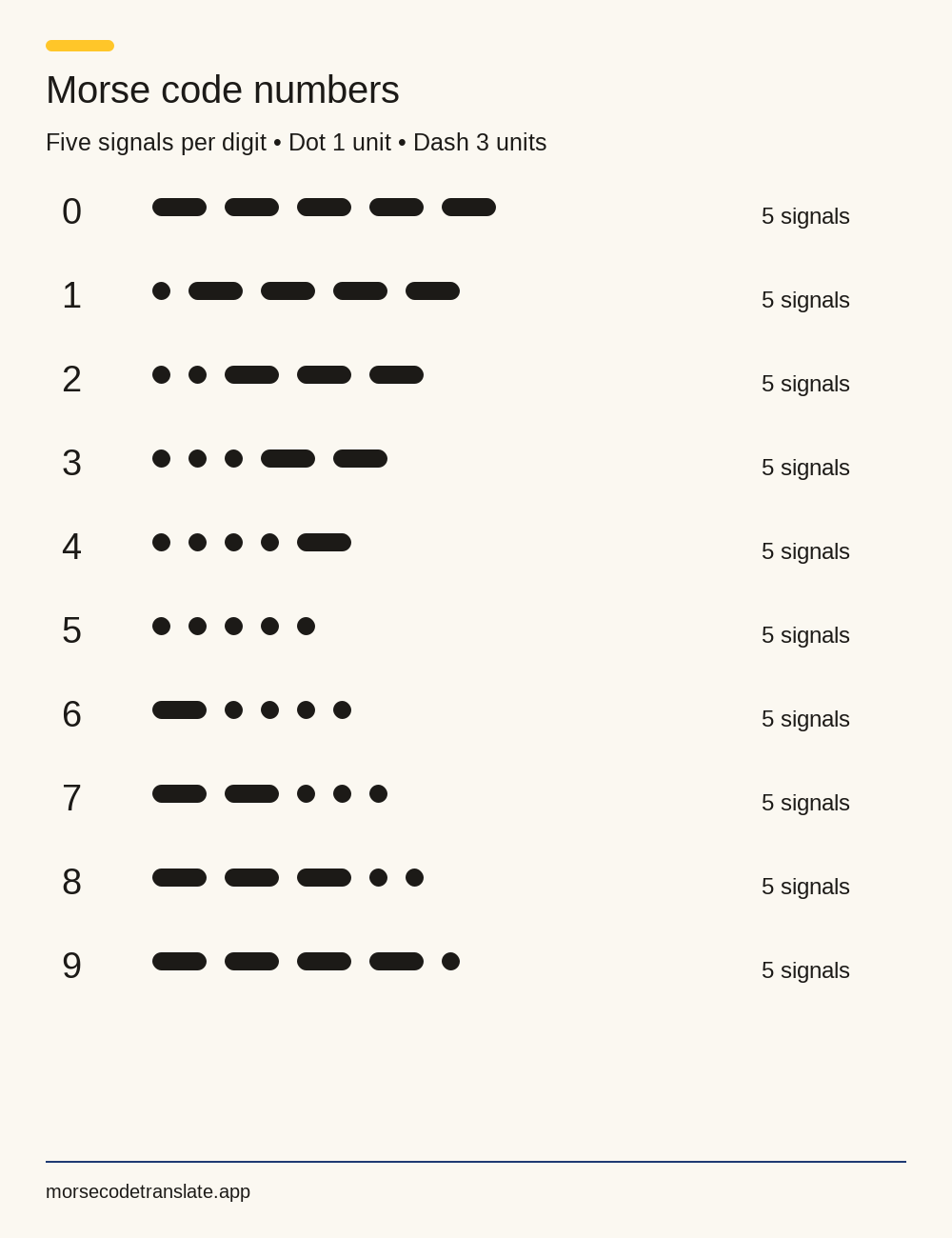
Open the chart to print or save it
Learn five, get ten
Take a digit from 1 to 5 and swap every dot for a dash and every dash for a dot. You get the digit five places later:
| Digit | Code | Dots and dashes swapped | That is |
|---|---|---|---|
| 1 | 6 | ||
| 2 | 7 | ||
| 3 | 8 | ||
| 4 | 9 | ||
| 5 | 0 |
So there are really only five shapes to learn, each with a mirror image.
How to tell a digit from a letter by ear
None of the letters A to Z has more than 4 signals, so a run of five with only one-unit gaps inside it is never one of them. Most often it is a digit, but five signals also belong to the accented É, to four marks (the slash, the left bracket, the double hyphen, and the plus sign), and to the service signals Understood, Wait, and the starting signal. Five signals alone do not prove a digit; the place in the message has to settle it (ITU-R M.1677-1, 2.2).
Then listen for where the rhythm turns. In 3 the turn comes after three short beats; in 8 it comes after three long ones. At first you will count. With practice each digit starts to sound like a word of its own, and the counting drops away.
Numbers above 9
There is no code for 10, 100 or any other number of its own. You send each digit in turn, with the usual three-unit gap between them, exactly as you would space the letters of a word:
- 1
- 0
- 2
- 5
- 1
- 0
- 0
That makes numbers long. From its first signal to its last, 100 takes 61 units, while the five-letter word PARIS takes 43 when counted the same way, without its word gap. Operators shorten some digits to a single letter, as the cut numbers below show. To apply this digit-by-digit method to a book clue, see The Caretaker Morse code guide.
What is 67 in Morse code?
67 is followed by . Read the first group as 6 and the second as 7. The ITU table assigns a separate pattern to each figure, so write both groups and keep a space between them; 67 has no combined character of its own (ITU-R M.1677-1, Part I, 1.1.2).
To type or copy the two groups: -.... --... (ITU-R M.1677-1, Part I, 1.1.2).
How do you say or send 67?
Say dah-di-di-di-dit, pause, then dah-dah-di-di-dit. These are the spoken rhythms for 6 and 7 in ARRL's number table (ARRL, Morse code numbers). To send them, keep each dash three dot lengths long, leave one dot length between signals inside each digit, and three between the two digits (ITU-R M.1677-1, Part I, section 2).
Dit and dah explains how to pronounce the syllables.
Do Morse code numbers turn into letters?
The international table gives letters and figures their own patterns. A is , while 1 is ; decoding the full signal for 1 gives the digit 1. Replacing numbers with alphabet positions would be an extra rule agreed separately. Read 67 here as the digits 6 and 7 (ITU-R M.1677-1, Part I, 1.1.1–1.1.2).
How to send 25th, 1¾, 2% and decimals
Morse has no superscripts, fraction characters or percent sign, so the international rules spell them out with figures, letters, the hyphen and the slash:
| You write | You send | Why |
|---|---|---|
| 25th | 25TH | A group of figures and letters goes out as one group, with normal character gaps and no word gap between the figures and letters, so an ordinal keeps its letters (ITU-R M.1677-1, Part I, 4.1–4.2) |
| 1¾ | 1-3/4 | A hyphen joins the whole number to its fraction; the ITU says to send 1-3/4, not 13/4. We think 13/4 would sound like thirteen quarters (ITU-R M.1677-1, Part I, 4.3) |
| 2% | 2-0/0 | The percent sign is sent as 0/0, joined to the number by a hyphen; 20/0 would be wrong (ITU-R M.1677-1, Part I, 3.3) |
| 146.670 | 146R670 | M.1677-1 gives no sign for a decimal point; in ARRL radiograms the letter R stands in for it (ARRL, NTS guidelines, 2002) |
For fractions and percent the ITU prints the form to avoid beside the rule, 13/4 and 20/0, but gives no reason. To hear any of them, type the “You send” form into the translator.
Cut numbers: when 9 becomes N
In radio contests, many stations shorten some digits to a single letter. ARRL calls these “cut numbers”, and its examples are A for 1, N for 9 and T for 0: a signal report of 599 and a power of 100 watts then go out as 5NN ATT (ARRL, 2019).
| Digit | Full code | Cut to | Code |
|---|---|---|---|
| 1 | A | ||
| 9 | N | ||
| 0 | T |
Each one keeps the digit's shape and squeezes its run of dashes into a single dash. With standard ITU spacing, the saving is real: 599 takes 49 units, 5NN only 25.
Cut numbers are an operating habit, not part of the international table, which lists only the full five-signal figures. Use them only where the other station expects them, as in a contest exchange. Anywhere else, send the digit in full.
Practice
Play all ten digits in the Morse code translator, or tap through them on the alphabet chart next to the letters. Learning them by sound works the same way as for letters, explained in How to learn Morse code by ear. For the marks that sit around numbers, such as the slash and the hyphen, see Morse code punctuation; for how long each gap lasts, see Morse code timing.
Sources
- Recommendation ITU-R M.1677-1, International Morse code. ITU Radiocommunication Sector, October 2009.
- February and March ARRL DX Contest Weekends Loom. ARRL News, 13 February 2019.
- NTS Methods and Practices Guidelines, Chapter 3: Transmitting Messages on CW. ARRL Public Service Communications Manual, Appendix B, version 3.01, May 2002.
- Learning Morse Code: spoken numbers. ARRL, checked 10 November 2026.