
- Translator
- Morse code tree
The Morse code tree
The Morse code tree is the alphabet arranged as a path. Start at the top, go left for every dot and right for every dash, and the letter where the signals end is the answer. E and T are one step down, and no letter from A to Z is more than four steps away (ITU-R M.1677-1, letter table).
How to read it: start at the top. Every dot takes you one step down to the left, every dash one step down to the right. When the signals run out, the letter you stand on is the answer, and the number of steps you took is the number of signals in its code. This diagram arranges the A–Z signals from ITU-R M.1677-1.
The tree, level by level
Each tile pair below hangs from the letter printed before it, one level up: the left letter adds a dot to that letter's code, the right letter adds a dash. Where a branch has no Latin letter, the pair shows only one, and O has none at all below. The codes follow the international standard, ITU-R M.1677-1 (ITU, 2009).
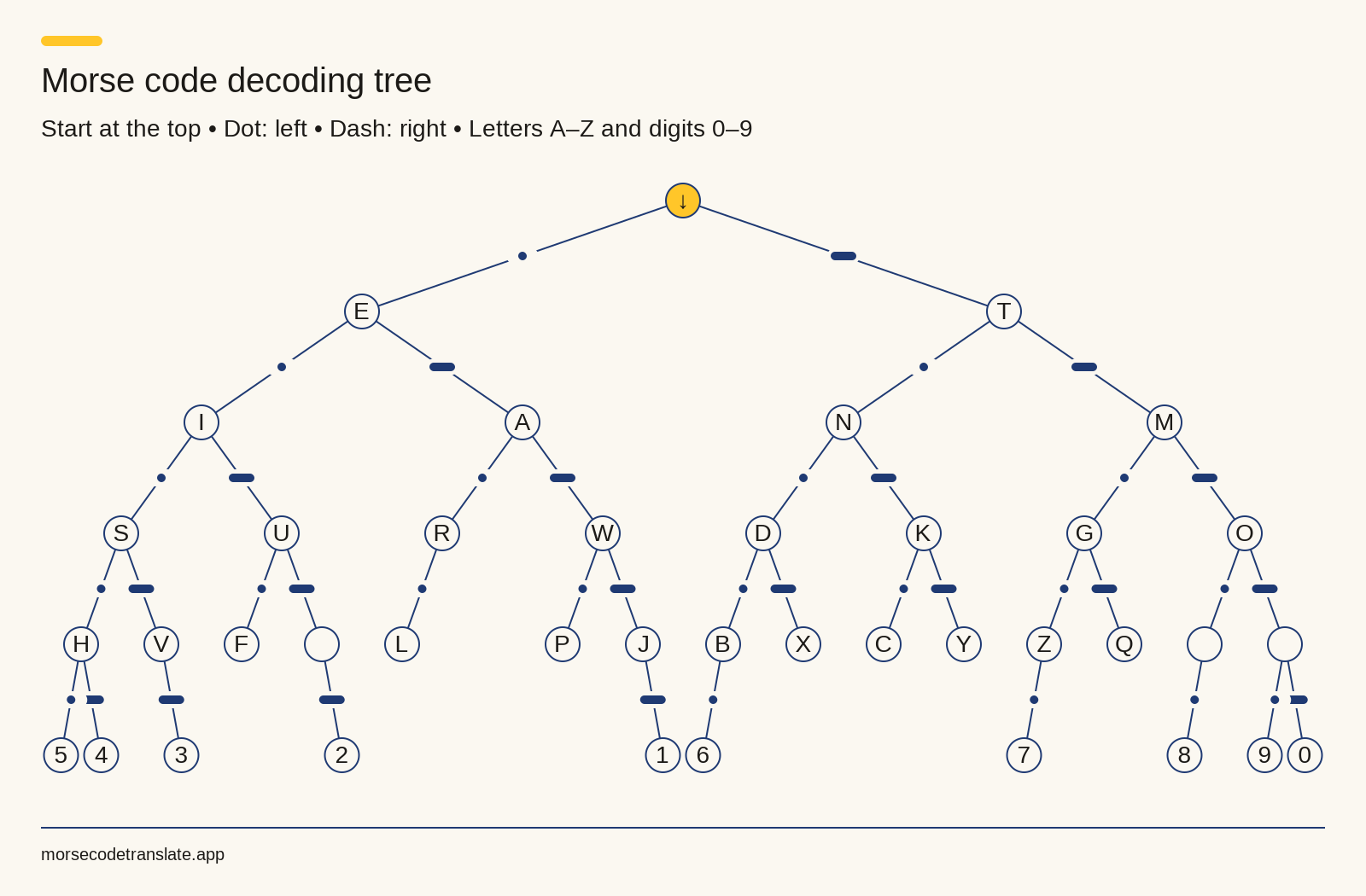
Open the chart to print or save it
The same tree, level by level, as a list:
Use I in Morse code to check a short path against the tree.
Level 1, one signal: 2 of 2 places hold a letter (ITU-R M.1677-1, letter table).
- Under the start: E, dot; T, dash
Level 2, two signals: 4 of 4 places hold a letter (ITU-R M.1677-1, letter table).
- Under E: I, dot dot; A, dot dash
- Under T: N, dash dot; M, dash dash
Level 3, three signals: 8 of 8 places hold a letter (ITU-R M.1677-1, letter table).
- Under I: S, dot dot dot; U, dot dot dash
- Under A: R, dot dash dot; W, dot dash dash
- Under N: D, dash dot dot; K, dash dot dash
- Under M: G, dash dash dot; O, dash dash dash
Level 4, four signals: 12 of 16 places hold a letter (ITU-R M.1677-1, letter table).
- Under S: H, dot dot dot dot; V, dot dot dot dash
- Under U: F, dot dot dash dot
- Under R: L, dot dash dot dot
- Under W: P, dot dash dash dot; J, dot dash dash dash
- Under D: B, dash dot dot dot; X, dash dot dot dash
- Under K: C, dash dot dash dot; Y, dash dot dash dash
- Under G: Z, dash dash dot dot; Q, dash dash dot dash
How to find a letter from its code
Say you see on a note. Start at the top and take one step per signal (ITU-R M.1677-1, letter R):
- Dot: go left to E.
- Dash: go right to A.
- Dot: go left to R.
Nothing is left, so the letter is R. If the signals run out on a place with no letter, the code was copied wrong or is not an A–Z letter (ITU-R M.1677-1, letter table).
Try the same lookup with K in Morse code and check each turn against its pattern.
How to find the code for a letter
Go the other way. Find the letter, then trace the line back up to the top and note each turn. Y hangs under K, which hangs under N, which hangs under T. Read from the top down, the turns are right, left, right, right: , said dash dot dash dash (ITU-R M.1677-1, letter table).
Use H in Morse code to practice the complete letter before tracing its path through the tree.
For another letter to trace back to the top, use J in Morse code.
What the shape tells you
- Short codes sit high. E and T are one step from the top, and no letter from A to Z is more than four steps down. The first four levels have 30 places, and 26 of them hold letters (ITU-R M.1677-1, letter table).
- Four places at the bottom are empty. The patterns , , , are not used by any letter, digit or punctuation mark in the international table (ITU-R M.1677-1, Part I). This translator's Russian alphabet fills all four with Cyrillic letters.
- Digits and punctuation hang lower. Every digit has 5 signals, so all of them sit on level 5; 9 of the 13 punctuation marks in this site's table have six (ITU-R M.1677-1, Part I).
- Depth is not duration. The tree counts signals, not time. A dash lasts three dots, with a one-dot gap between signals, so M, on level 2, takes 7 units, while S, on level 3, takes 5. On level 4, H takes 7 units and J takes 13 (ITU-R M.1677-1, letter table and section 2). Morse code timing shows the signal and gap rules.
When the tree helps
- Reading code you can see. A note, a bracelet, a blinking light you wrote down: with the tree you can decode it in a few steps without hunting through a chart.
- Checking what you send. When you send on one key, each press is one step: a short tap goes left, a long hold goes right. The tree shows where a wrong press lands you.
- Seeing the system. The tree shows at a glance that E and T have the shortest codes and that every digit has more signals than every A–Z letter (ITU-R M.1677-1, letter and figure tables).
- Writing a decoder. For programmers, the tree is a binary tree: taking one branch per signal reads an A–Z letter in at most four comparisons, a digit five. Those bounds follow from the longest codes in the ITU letter and figure tables.
If the letter boundaries are missing, Decode Morse code without spaces shows why one string can have several readings.
Is the Morse code tree a binary search tree or a Huffman tree?
It is a binary tree, but not an alphabetic binary search tree or a Huffman coding tree. Every place has at most two branches, a dot and a dash, which fits the definition of a binary tree (NIST, binary tree). The differences are visible in the tree above.
A binary search tree keeps every key in a node's left subtree smaller than the node and every key in its right subtree larger (NIST, binary search tree). Read the Morse tree in that order, left branch, then the node, then the right branch, and the letters come out as H S V I F U E L R A P W J B D X N C K Y T Z G Q M O, which is not alphabetical. The tree arranges letters by signals, not by their place in the alphabet.
A prefix code is a set of code words in which no word is the start of another, and it can be drawn as a coding tree (NIST, prefix code). Morse letters do not work that way: 13 of the 26 letters open the code of another letter. E, , is the first signal of I, , and I is the start of S, . Those letters sit on inner places of the tree, not at its ends. A decoder therefore cannot tell from the signals alone where a letter stops; it needs the gap, which the standard sets at three units between letters (ITU-R M.1677-1, section 2).
Huffman coding builds a tree from character frequencies, so that frequent characters sit near the root and rare ones far from it (NIST, Huffman coding). The top of the Morse tree looks similar, with E and T one step from the root, but the shape alone does not show how the table was designed. Is there any logic to Morse code? checks the frequency idea against the evidence, and Morse code vs binary explains why Morse is not a fixed-width binary code.
When it gets in the way
Listening is where the tree stops helping. At 18 words per minute one dot lasts about 67 ms, and all of J is over in about 870 ms: four turns down the tree in less than a second, before the next letter starts. These durations use standard PARIS timing and the international signal lengths (ARRL, QEX, April 1990; ITU-R M.1677-1, section 2). The ARRL article notes that above a few words per minute, Morse is most easily read by ear when characters are recognized rhythmically rather than by counting the dots and dashes (ARRL, QEX, 1990). Walking the tree is counting.
The psychologist Ludwig Koch observed something similar in 1936. Learners who memorized the written dots and dashes first kept translating every sound through that picture, and the detour slowed them down (Koch 1936, p. 27–30). The memory aids of his day grouped letters made only of dots, E, I, S, H, and only of dashes, T, M, O: the tree's two outer edges. Koch's group experiment was a different test, of teaching letters in groups at 90 to 100 characters a minute rather than of those memory aids: he taught the dash group and the dot group separately, and when he mixed them the eight letters had to be learned again almost from the beginning (Koch 1936, p. 50).
So use the tree to understand Morse and to look codes up, and learn to hear letters as whole sounds. How to memorize Morse code explains what to do instead of a chart. How to learn Morse code by ear gives the method step by step. The Morse code alphabet plays every letter on tap, and the translator turns any word into code.
Sources
- Recommendation ITU-R M.1677-1, International Morse code. ITU Radiocommunication Sector, October 2009.
- A Standard for Morse Timing Using the Farnsworth Technique, Jon Bloom, KE3Z. ARRL, QEX, April 1990.
- Ludwig Koch, work-psychological study of radio telegraphy learning (English translation). Hosted by the Long Island CW Club; unofficial translation, original 1936.
- binary search tree. NIST, Dictionary of Algorithms and Data Structures, checked 11 November 2026.
- prefix code. NIST, Dictionary of Algorithms and Data Structures, entry modified 11 February 2019.
- Huffman coding. NIST, Dictionary of Algorithms and Data Structures, checked 11 November 2026.
- binary tree. NIST, Dictionary of Algorithms and Data Structures, entry modified 15 December 2017.