
- Translator
- Wabun code
Wabun code: Japanese Morse code
Wabun code is Japanese Morse code: 48 kana have their own signals, listed in iroha order in Japan's Radio Station Operation Rules. Most kana send the same dots and dashes as a Latin letter, so a receiver has to know which table a message uses.
In short:
- Wabun code (和文) is Japanese Morse: each of the table’s 48 kana, the Japanese syllable symbols, has a signal of its own.
- Japan's Radio Station Operation Rules print it as part 1 of Appended Table 1, with the Latin part (欧文) as part 2.
- The kana come in iroha order: イ, ロ, ハ, ニ, ホ, ヘ, ト and on.
- 25 of the 48 kana send the signal of a Latin letter, so the same dots and dashes mean different things in the two parts.
Wabun code translator
Type kana to see each kana's signal, or switch to Signals to kana and type signals. Hiragana is converted to katakana, the script the table prints. Listen plays the signals as sound and Flash as light. Everything runs in this tab: nothing you type is sent anywhere.
This translator needs JavaScript. Without it, look each kana up in the chart below.
Try
It translates the 48 kana of the chart and the three marks listed after it. A voiced kana such as バ is sent as the plain kana and the dakuten ゛ as a mark of its own, shown as a separate tile; the rules print no sending order for the marks, so pick the order you agreed with your partner. Figures, punctuation, small kana such as ッ, kanji and Latin letters are marked, not guessed, and skipped when the message plays.
What is wabun code?
Wabun means “Japanese text”, the label the rules give to part 1 of the table (Radio Station Operation Rules, Appended Table 1). English Morse code spells words with letters; wabun spells Japanese words with kana, so it needs a table of its own. A museum catalog in Japan dates Morse telegraphs, which sent the alphabet and the iroha characters, to the telegraph offices of about 1873 (Toyota Commemorative Museum, exhibit 2).
As of November 2026, the table is part of Japan's Radio Station Operation Rules, and Article 12 requires Morse radiotelegraphy to use its codes (Radio Station Operation Rules, art. 12). The wabun part shown here is one of the table's two parts (Radio Station Operation Rules, Appended Table 1). Morse code in other languages covers the other part and the iroha order.
The wabun chart, in iroha order
The table lists the kana in a fixed order, and it is the one called iroha. Merriam-Webster defines iroha as “the Japanese kana in its popular order” (Merriam-Webster), and the table begins イ, ロ, ハ, ニ, ホ, ヘ, ト. Two kana, ヰ and ヱ, are in the table. The last entry is ン.
| Kana | Signal | Kana | Signal | Kana | Signal | Kana | Signal |
|---|---|---|---|---|---|---|---|
| イ | ロ | ハ | ニ | ||||
| ホ | ヘ | ト | チ | ||||
| リ | ヌ | ル | ヲ | ||||
| ワ | カ | ヨ | タ | ||||
| レ | ソ | ツ | ネ | ||||
| ナ | ラ | ム | ウ | ||||
| ヰ | ノ | オ | ク | ||||
| ヤ | マ | ケ | フ | ||||
| コ | エ | テ | ア | ||||
| サ | キ | ユ | メ | ||||
| ミ | シ | ヱ | ヒ | ||||
| モ | セ | ス | ン |
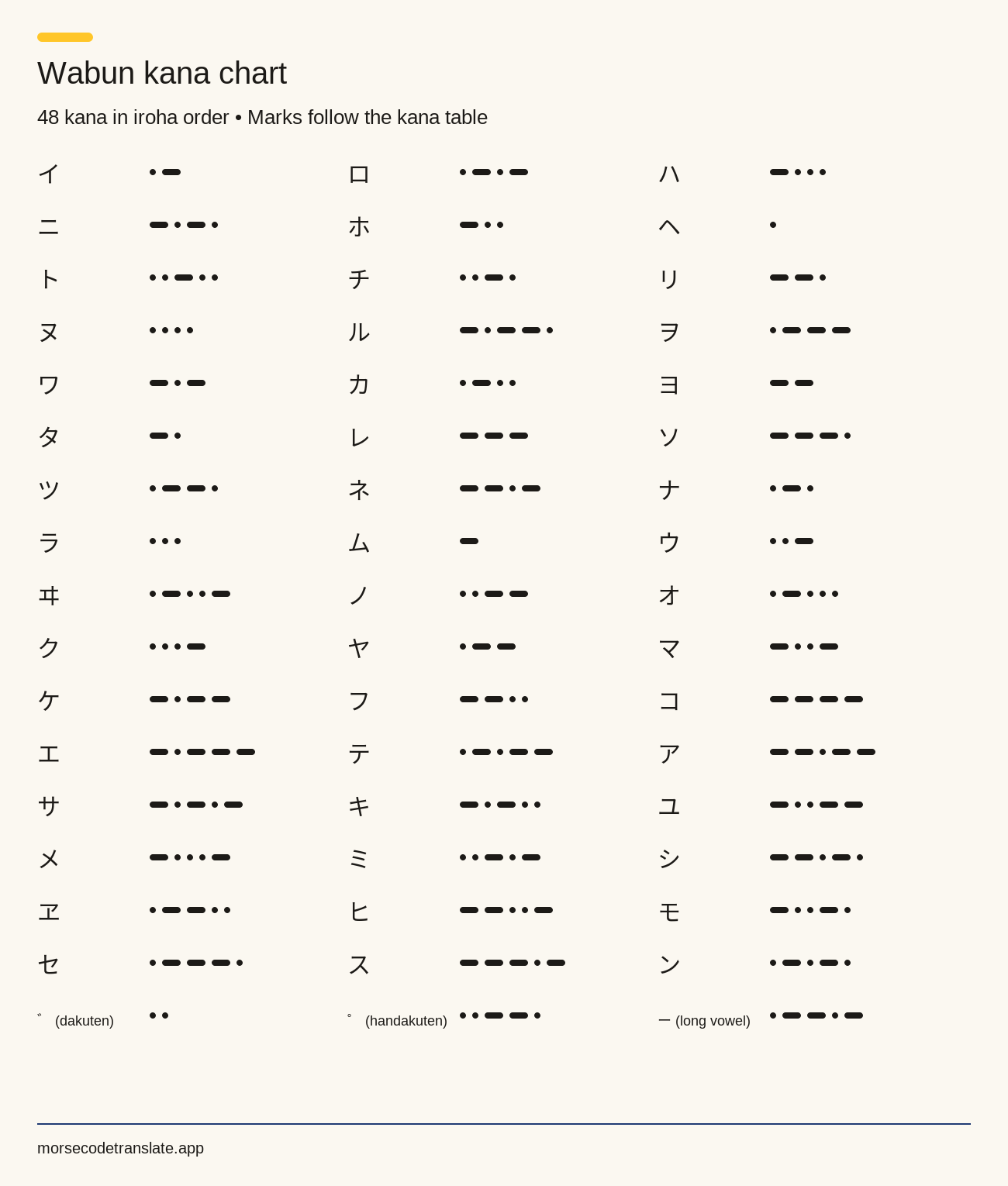
Open the chart to print or save it
Each signal was checked against the e-Gov text of the table (Radio Station Operation Rules, Appended Table 1) and its official XML. They are drawn, not played, because a signal sounds the same in either part of the table, as the next section shows. Hear A, B and C in the translator
The table has no separate signals for voiced kana such as バ or パ. It gives the plain kana, then the dakuten and handakuten at the end of the kana group, and the long-vowel mark ー in the signs group of the table (Radio Station Operation Rules, Appended Table 1):
- ゛ (dakuten):
- ゜ (handakuten):
- ー (long vowel):
The table goes on with the figures, which have the same signals as the figures in the European part, and with a few more signs.
How wabun shares signals with Latin letters
This is where wabun surprises English readers. Compare each kana's signal with the Latin table, and 25 of the 48 kana turn out to send the same dots and dashes as a Latin letter. The one remaining Latin letter, I, has the signal of the dakuten, the voicing mark . So every letter from A to Z has a partner in the wabun part of the table. イ, the first kana, sends , the signal of A.
| Signal | Latin letter | Kana |
|---|---|---|
| A | イ | |
| B | ハ | |
| C | ニ | |
| D | ホ | |
| E | ヘ | |
| F | チ | |
| G | リ | |
| H | ヌ | |
| J | ヲ | |
| K | ワ | |
| L | カ | |
| M | ヨ | |
| N | タ | |
| O | レ | |
| P | ツ | |
| Q | ネ | |
| R | ナ | |
| S | ラ | |
| T | ム | |
| U | ウ | |
| V | ク | |
| W | ヤ | |
| X | マ | |
| Y | ケ | |
| Z | フ |
That is why a receiver has to know which part of the table a signal belongs to. The two parts of the table are printed one after the other, but on the wire the signals are the same.
How a message tells the receiver which one is coming
The rules answer in two ways. Among the abbreviations used only for domestic communication, the table lists ワブン (“Japanese-text message”) and オウブン (“European-text message”), both spelled out in kana (Radio Station Operation Rules, Appended Table 2, part 2 (2)).
The same list has two run-together signals, written with a line over the kana; the law prints them as images, not as text (Radio Station Operation Rules, Appended Table 2, part 2 (2)). The note to the table says that such an abbreviation is sent as one signal (Radio Station Operation Rules, Appended Table 2, part 2 (2)). One is ホレ, for the text of a message. Run together, its two kana make , the dots and dashes of DO. The other, ラタ, ends or corrects a Japanese-text message and makes , the dots and dashes of SN. Article 29 ends a Japanese-text message with ラタ and a European-text message with AR (Radio Station Operation Rules, art. 29).
Wikipedia's article on wabun code says that, when wabun is mixed with International Morse, DO announces the start of wabun and SN the return to the international code. We could not confirm that in the rules, so this guide only says what the table shows: the signals are the same. Morse code prosigns explains why run-together signals exist.
How fast is wabun sent?
For manual sending the rules set a standard of 75 kana a minute in wabun, against 20 words a minute for plain European text and 16 for coded text. For distress, urgency and safety messages the limit is, in principle, 70 kana a minute (Radio Station Operation Rules, art. 15). Morse code speed (WPM) shows how Latin speeds are counted.
When did Japan start using telegraphs, and where did wabun come in?
Japan's first telegraph service linked Tokyo and Yokohama on 14 September 1869 (National Diet Library). The Toshiba Science Museum shows a Breguet dial telegraph “used in 1869, initiating the telegraph communication age”. It points at letters on a disk and needs no code table, but it was slower and could not work over long distances, which is why the Morse telegraph soon became the mainstream (Toshiba Science Museum). We did not find a dated source for the first kana table, so this guide does not give a year for it. How the telegraph worked explains the machines.
Can you turn wabun code into English?
Not directly. Wabun decodes to kana, so the result is Japanese sounds written in kana, not English. Translate the Japanese text afterward with an ordinary text translator. A table that gives a signal for each of 48 kana can only be read back as kana (Radio Station Operation Rules, Appended Table 1).
How do you write a Japanese message in wabun?
- Write the message in kana. Part 1 of the table lists kana, figures and a few signs. It has no signals for kanji, and Latin letters are in part 2 (Radio Station Operation Rules, Appended Table 1).
- Look each kana up in the chart above, and write its signal next to it.
- Add the marks. The table prints the dakuten and handakuten as signals of their own, and gives none for voiced kana such as バ (Radio Station Operation Rules, Appended Table 1). We found no sentence in the rules that shows the sending order, so agree it with your partner.
- Say which table you are using. The same dots and dashes also read as Latin letters, as shown above. Russian Morse code has the same issue for Cyrillic. Korean Morse code covers Korean.
Learning wabun, and where to go next
Because kana share signals with Latin letters, a learner who knows International Morse already knows the signals of more than half the kana. The rest follows the same rule as the Latin alphabet: learn by ear, not from a chart. How to learn Morse code by ear teaches that method with the Latin letters, and the Morse code alphabet is the chart for the European part. For other scripts and the tables that differ from the international one, see Morse code in other languages. American vs International Morse shows another case of different Morse tables.
Sources
- Radio Station Operation Rules (無線局運用規則), Radio Regulatory Commission Rule No. 17 of 1950, Article 12 and Appended Table 1. e-Gov Laws, Government of Japan, checked 6 November 2026.
- Radio Station Operation Rules: official XML, Articles 12 and 15 and Appended Tables 1 and 2. e-Gov Laws, Government of Japan, checked 10 November 2026.
- iroha, Merriam-Webster.com Dictionary. Merriam-Webster; Wayback Machine capture of 18 November 2025, checked 7 November 2026.
- Morse telegraphy (モールス符号電信機), virtual exhibition room 360, exhibit 2. Toyota Commemorative Museum of Industry and Technology, checked 7 November 2026.
- Cipher Wheel of The Meiji Era's Cryptographic Wheel (column 2, Modern Japan in archives). National Diet Library, Japan, checked 11 November 2026.
- Founders' Room Telegraph: Breguet Dial Telegraph (replica). Toshiba Science Museum, checked 11 November 2026.