
- Translator
- Semaphore alphabet
Semaphore alphabet chart
The semaphore alphabet spells letters with pairs of flag positions. This A–Z chart shows the signaler facing you, so its directions match what you see on the page.
In short. Flag semaphore gives each letter a pair of flag positions. Read this chart as though you are facing the signaler. Find both directions together; one flag alone does not identify the letter (Scouting America, pp. 22–23).
Semaphore alphabet chart: A to Z
The positions below follow Scouting America's receiver-facing chart. Every left and right direction describes what you see, rather than the sender's own left and right (Scouting America, pp. 22–23).
Each card is one complete letter. Under the drawing, the two flag directions are named as you see them: the sender's right arm first, then the left. The slash separates the two flags. It does not mean “choose either.”
- Adown-left / down
- Bleft / down
- Cup-left / down
- Dup / down
- Edown / up-right
- Fdown / right
- Gdown / down-right
- Hleft / down-left
- Iup-left / down-left
- Jup / right
- Kdown-left / up
- Ldown-left / up-right
- Mdown-left / right
- Ndown-left / down-right
- Oleft / up-left
- Pleft / up
- Qleft / up-right
- Rleft / right
- Sleft / down-right
- Tup-left / up
- Uup-left / up-right
- Vup / down-right
- Wup-right / right
- Xup-right / down-right
- Yup-left / right
- Zdown-right / right
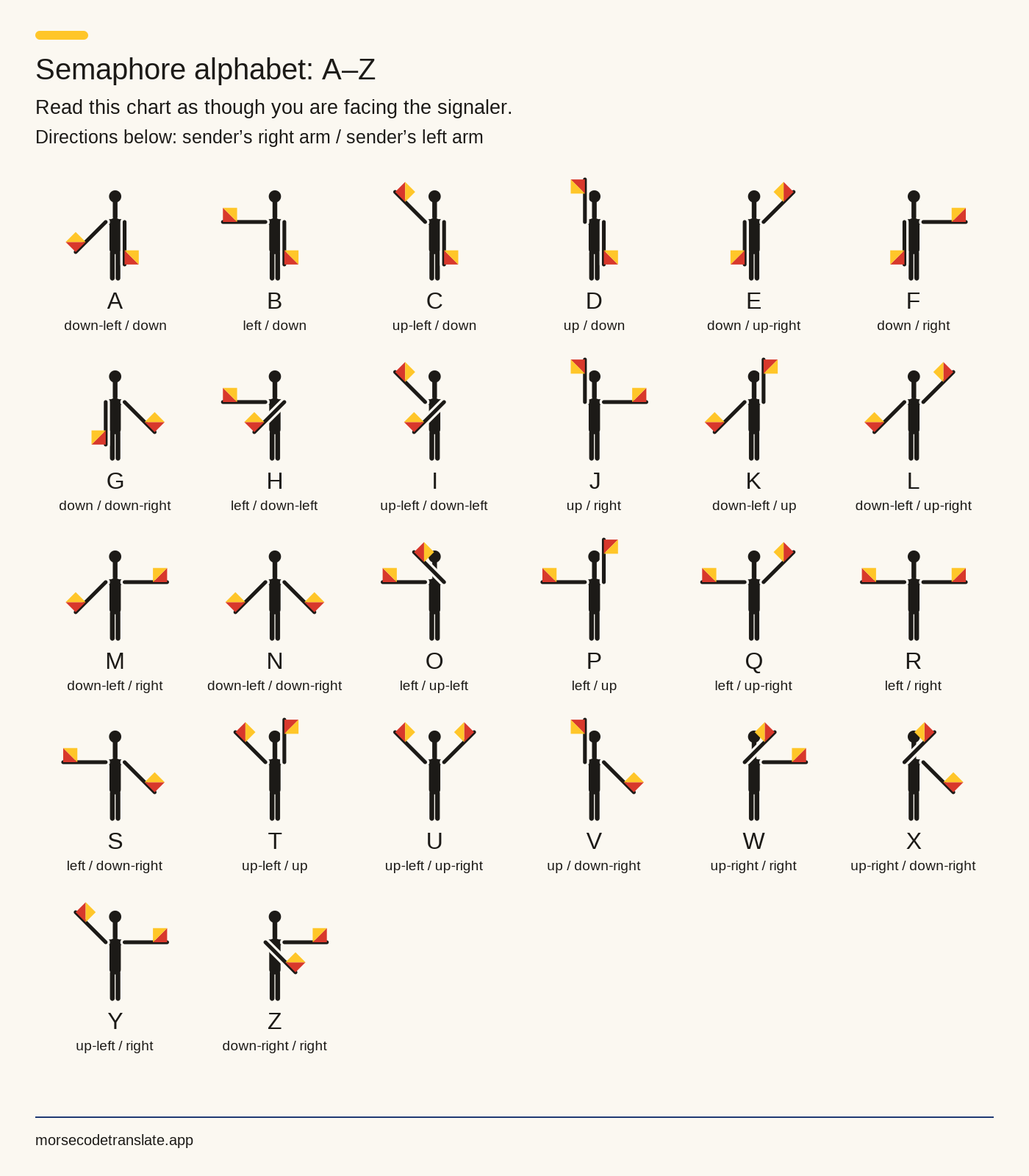
Open the chart to print or save it
How to read a semaphore letter
Start with one still picture. Point to each flag and name its direction before looking for a letter. Then scan the chart for that pair. This gives you something concrete to compare, instead of guessing a letter from the general shape.
Try A first: one flag points down-left and the other down. Compare it with G, whose diagonal points down-right. R stretches horizontally to both sides (Scouting America, pp. 22–23). Use these as checkpoints when you return to a puzzle or a sequence of photographs.
Keep the chart's viewpoint written on your working sheet. When you stand opposite someone, the arm on your left belongs to their right side. If you are copying a picture, compare the picture directly with the drawings. If you are sending, have your partner compare what they see with the chart.
For an unreadable pose, record the two directions you can see and leave a question mark beside the letter. Keep the original picture. Return to the uncertain entry after checking its neighbors, rather than changing its angles to fit a word you expect.
Practice sending and receiving
Keep your arms straight (U.S. Navy, p. 325). Make each position crisp, so your partner knows exactly where each flag points (Scouting America, p. 23). The Navy's Motor Torpedo Boat Manual adds that pivoting the body at the waist makes some letters clearer. It names H, I, O, W and X, where both flags are on the same side (U.S. Navy, p. 325).
- Pick a small set. Begin with A, B, C and D. Have a partner choose one without telling you which it is. Write your answer before checking the chart.
- Swap jobs. Send the same set back. Ask your partner to name the directions they saw if they read a different letter.
- Add one contrast. Compare B with C, then C with D. Change one angle at a time and check the completed pose.
- Try a short word. Add G and try BAG, then CAB. Agree on the word in advance for your first attempts, then try a new word without revealing it.
- Keep a correction list. Note the two letters you confused. Practice that pair again before adding more letters.
Do a receiving round with the chart available, then cover it for the next round. You can also ask your partner to photograph a completed practice position and compare it afterward. Use the photograph to discuss the two angles, without trying to infer a whole message from one frame.
An alphabet chart is only part of exchanging messages. The Navy manual also lists special signs: one to call for attention, one to answer, and a “front” sign used before and after each word (U.S. Navy, p. 326). For a class or Scout activity, agree on the procedure with your instructor before sending full sentences.

How do you send a whole message in semaphore?
Use agreed signals around the letters: get the receiver's attention, spell each word, and confirm each word as you go. Scouting America's pamphlet describes the routine (Scouting America, p. 24):
- Make the attention signal. When the receiver sends C, you may go ahead.
- Spell a word and mark its end with the rest signal. Two rests mark the end of a sentence.
- The receiver answers each word with C. If the receiver sends IMI, for “I missed it”, repeat that word and go on from there.
- If you make an error, send eight Es, then start the word again from the beginning.
- End with AR and wait for the receiver to send R. Then you know the message arrived.
The pamphlet also says to separate double letters, such as the two Ls in HILL, with the rest signal, and to receive for at least half of your practice time, because sending is easier than receiving (Scouting America, pp. 21 and 24).
How do you send numbers and punctuation in semaphore?
Spell numbers out, and spell out any punctuation too, because semaphore has no punctuation marks. The pamphlet says Navy signalers always spell out numbers such as “ONE” and “TWO” (Scouting America, p. 21). A numeral signal exists: the letters sent after it are read as numbers, with A to I for 1 to 9 and K for 0. The pamphlet advises against relying on it, because it invites mistakes (Scouting America, p. 21).
How far can you signal with semaphore?
Not far, and only in daylight. The pamphlet puts the range at typically not more than a mile, with good visibility and the sender and receiver in plain sight of each other. Flags only make the positions easier to see; hands work too (Scouting America, p. 19). In an emergency, call 911 or your local emergency number first. Never count on anyone seeing a signal. Distress signals covers signals meant for rescuers. For signaling by light instead of flags, see Aldis lamp and signal lamps.
Where does flag semaphore come from?
It borrows its name and basic movements from an earlier system of mechanical movable arms on towers (Scouting America, p. 19). The pamphlet credits the Chappe brothers in France with that system in the late 18th century, and says Samuel Morse saw advanced semaphore systems in action before he had the idea of sending messages by electricity (Scouting America, pp. 10–11). The Science Museum Group's collection includes a model of a Chappe tower (Science Museum Group). For what came next, see How the telegraph worked and Who invented Morse code?. The pamphlet adds that semaphore has been a traditional code in the U.S. Coast Guard, Army and especially the Navy (Scouting America, p. 18).
Is semaphore the same as Morse code?
No. Semaphore letters use pairs of positions. Morse letters use ordered short and long signals. For example, International Morse A is , a dot followed by a dash. The dash lasts three dot units, with a one-unit gap inside the letter (ITU, Annex 1, sections 1.1.1 and 2). Holding a semaphore A longer does not turn it into a Morse dash.
The player below demonstrates Morse A. Compare that sequence over time with the single A pose in the flag chart above.
For the other timed patterns, use the Morse code alphabet. To practice recognizing those patterns as sounds, try learning Morse code by ear. Keep your practice goal specific: reading flag positions and recognizing a rhythm are different exercises.
Can I use a semaphore alphabet translator?
A useful check is to give a tool a single known letter before a whole sentence. Enter A and compare the result with this chart. Find the tool's viewpoint label, then test a letter with flags on the same side, such as W. Do the comparison before copying a long output into a worksheet.
This site's translator converts Morse code. To compare the same letter in that system, open A in the Morse translator. Use the flag chart above for semaphore positions. For a different letter-by-letter comparison, try the tap-code grid. For a Scout activity, consult the Signs, Signals, and Codes badge guide.
Semaphore alphabet PDF: print the chart
Use your browser's Print command to make a reference copy. In Chrome, press Ctrl+P on Windows or Linux, or Command+P on a Mac. Then choose a destination and review the print settings (Google Chrome Help). For a file instead of paper, pick the PDF option in the destination list.
Check the preview before saving or printing. Make sure A and Z are both included and each drawing keeps its letter and direction words. Keep the note about the viewpoint with the chart, so another reader knows the signaler is facing them. For a practice sheet, leave room beside the printed letters to record your own answers.
Sources
- Signs, Signals, and Codes, semaphore chart, pages 22–23. Scouting America, 2026 printing; checked 10 November 2026.
- Motor Torpedo Boat Manual, Part IV, Chapter 3: Visual Communications and Code. U.S. Navy; transcription at HyperWar, ibiblio, checked 10 November 2026.
- Recommendation ITU-R M.1677-1, International Morse code. ITU Radiocommunication Sector, October 2009.
- Print from Chrome. Google Chrome Help, checked 10 November 2026.
- One model of Chappe semaphore tower (object 1933-648). Science Museum Group, checked 11 November 2026.