
- Translator
- Signal flags translator
Signal flags translator
Translate letters and numbers into International Code of Signals flags, or select flags to read their letters. Use the chart to check each flag’s separate single-letter meaning.
This signal flags translator spells your text with the International Code of Signals alphabet flags and numeral pennants. To read a sequence, select its flags in order. The chart also gives each letter's separate code meaning (NGA Pub. 102, flag plate and p. 21).
Translate text and flag letters
Everything runs in your browser. What you type stays on this device.
Enable JavaScript to generate a row or select flags. The complete reference chart below works without it.
Use A–Z, 0–9 and spaces, up to 240 characters. In Flags to text, tap chart flags in reading order, or type their letters.
Flag row
Text:
How do I translate text into nautical flags?
Type a word, name, or number in Text to flags. Lowercase English letters become capitals. Spaces separate words, and a question mark shows an unsupported character. The tool accepts A–Z and 0–9; it does not convert accents, punctuation, emoji, or other alphabets. Remove an unsupported character or replace it with the spelling you want before printing.
Repeated letters produce repeated flags.
The designs below follow the International Flags and Pennants plate in the official US government publication (NGA Pub. 102, inside-front-cover plate). The drawings are geometric reference illustrations, with the hoist edge on the left. Colors stay red, blue, yellow, black, and white in either screen theme; outlines keep white areas visible. Your screen and printer may reproduce those colors differently.
How do I read a sequence of boat flags?
Choose Flags to text, clear the example, and find each visible flag in the chart. Press its Add button in the order you want to read it. Use Add space between words and Undo last character if you choose the wrong flag. You can also type flag letters and digits directly.
This is a manual boat flag translator: you identify the designs. It does not recognize flags in a photograph or decide which flag comes first in a real hoist. Compare both shapes and colors. For example, Alfa and Bravo have a notch at the fly, while the numeral pennants taper toward a short fly edge (NGA Pub. 102, flag plate).
Do not read every real hoist as an English word. The Code assigns complete meanings to signals, including single-letter signals and longer code groups. The spelling shown here does not look up two-letter groups, medical signals, complements, substitutes, or answering-pennant procedures (NGA Pub. 102, Chapter 1, sections 1 and 5). Use the publication for those rules.
Signal flag alphabet and single-letter meanings
Each chart entry names the flag and summarizes its single-letter meaning. Context matters: Golf and Zulu have additional meanings for fishing vessels in close proximity on the fishing grounds, and Papa has harbor, fishing, and sound-signaling uses. Romeo has no assigned single-letter message in this table. The numeral pennants represent figures (NGA Pub. 102, p. 21 and flag plate).
Charlie can also affirm the preceding group; November can negate it. November is used visually or by sound; voice or radio uses NO. Kilo and Sierra have special meanings when used as landing signals for small boats carrying people in distress. The chart summarizes flag meanings; consult the publication’s notes before using these letters as sound signals (NGA Pub. 102, p. 21, including notes 1–2).
I have a diver down; keep well clear at slow speed.
I am taking in, or discharging, or carrying dangerous goods.
Yes (affirmative).
Keep clear of me; I am maneuvering with difficulty.
I am altering my course to starboard.
I am disabled; communicate with me.
I require a pilot. Fishing vessels in close proximity on the fishing grounds: I am hauling nets.
I have a pilot on board.
I am altering my course to port.
I am on fire and have dangerous cargo on board: keep well clear of me, or I am leaking dangerous cargo.
I wish to communicate with you.
You should stop your vessel instantly.
My vessel is stopped and making no way through the water.
No (negative).
Man overboard.
In harbor: all persons should report on board as the vessel is about to proceed to sea. At sea, fishing vessels: my nets have come fast upon an obstruction. May also mean: I require a pilot, by sound.
My vessel is healthy and I request free pratique.
No single-letter meaning in this table.
I am operating astern propulsion.
Keep clear of me; I am engaged in pair trawling.
You are running into danger.
I require assistance.
I require medical assistance.
Stop carrying out your intentions and watch for my signals.
I am dragging my anchor.
I require a tug. Fishing vessels in close proximity on the fishing grounds: I am shooting nets.
Numeral 0.
Numeral 1.
Numeral 2.
Numeral 3.
Numeral 4.
Numeral 5.
Numeral 6.
Numeral 7.
Numeral 8.
Numeral 9.
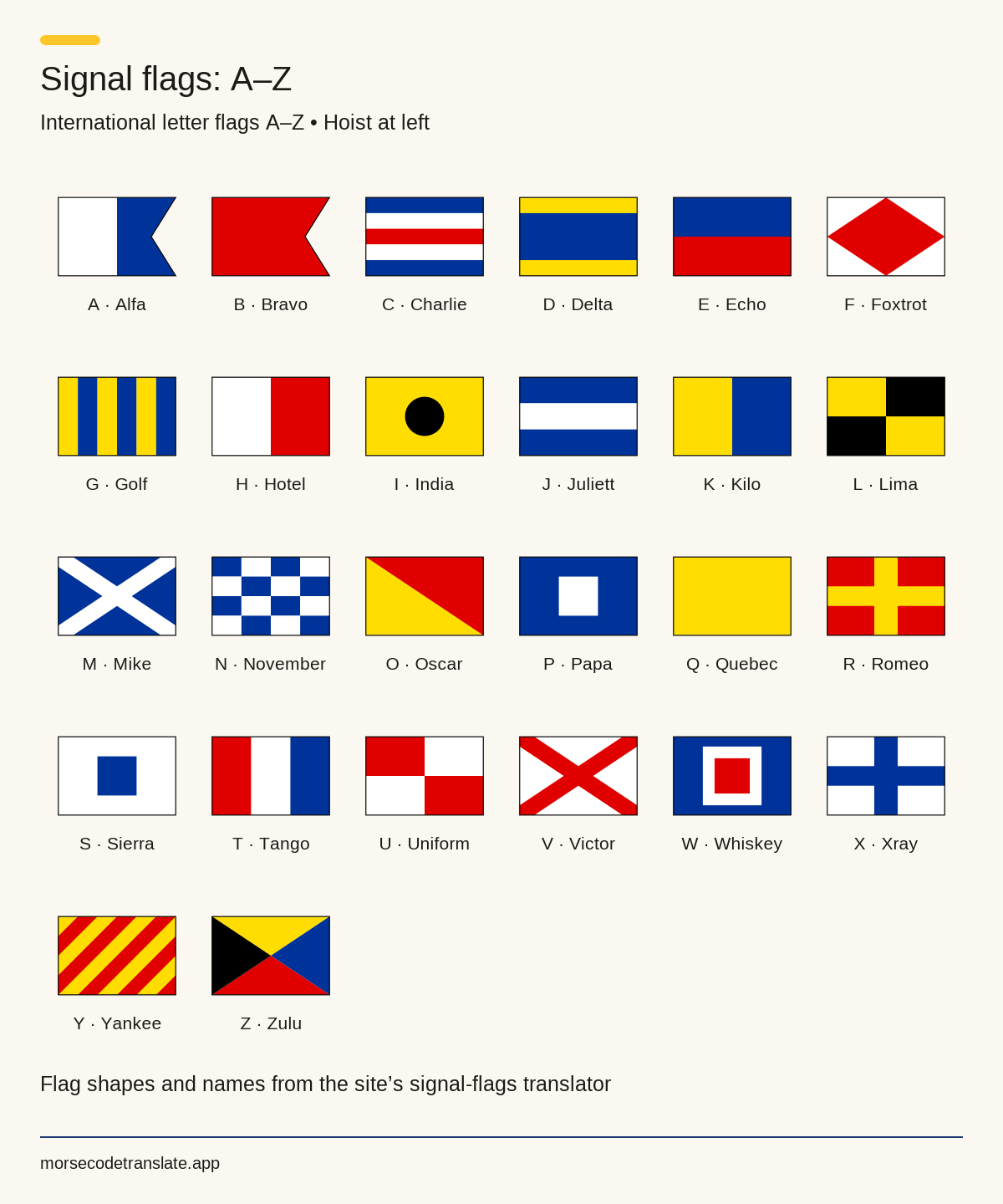
Open the chart to print or save it
Does a flag mean a letter or a message?
A flag can identify a letter or carry a complete code message, depending on how you use it. When you use this tool to spell a name, Alfa supplies A. As a single-letter signal, Alfa announces a diver down and asks other vessels to keep well clear at slow speed. The full meaning matters; treating it as only the letter A would miss the message (NGA Pub. 102, p. 21).
Likewise, Whiskey requests medical assistance, and Oscar signals a person overboard. The code meaning is separate from the letter label underneath each picture (NGA Pub. 102, p. 21). This page is for learning and checking spelling; it is not a substitute for maritime operating procedures. In an emergency, contact the appropriate emergency service first.
For a navy signal flags translation, first check which code your source uses. This tool covers the International Code of Signals, rather than every naval signaling system.
Are signal flags Morse code?
No. These flags identify characters through a colored design. Morse identifies characters through timed short and long signals. The International Code of Signals describes flag signaling and flashing-light signaling separately; its flashing-light instructions use Morse (NGA Pub. 102, Chapter 1, section 3, p. 4; sections 5–6, pp. 8–11). The same letters can therefore be represented both ways, without making a flag pattern a Morse pattern. To compare Whiskey's letter with its Morse pattern, see W in Morse code.
Compare HELLO as five flags with the Morse widgets below. Read the labels from left to right, then use Listen or Flash. The flag row itself does not flash.
- H
- E
- L
- L
- O
Use the Morse code alphabet to compare individual characters, or open the Morse translator for your own phrase. To practice the sound rather than the colored shapes, start with learning Morse code by ear. Semaphore and the NATO phonetic alphabet offer other ways to represent letters.
Make a nautical flag alphabet printable
Enter the row you want and press Print flag row. The print layout includes the generated flags, their letter labels, and the text they spell. For an alphabet reference row, type the letters A to Z in order; add the digits 0 to 9 if you want the numeral pennants too.
Review the print preview before choosing paper or saving a PDF. Check that every flag and its label appear, and use color output if you need to distinguish the designs. A black-and-white copy can hide the difference between flags. Keep the text labels with the pictures.
Sources
- International Code of Signals, Pub. 102: flag plate; Chapter 1, sections 3 and 5–6; single-letter signals, p. 21. National Geospatial-Intelligence Agency, 1969 edition, revised 2020; checked 11 November 2026.