
- Translator
- NATO alphabet
NATO phonetic alphabet
The NATO phonetic alphabet uses words such as Alfa, Bravo and Charlie in place of spoken letter names. Use this chart to spell letters aloud or compare each letter with its Morse code signal.
In short. The NATO phonetic alphabet replaces spoken letter names with words: Alfa for A, Bravo for B and Charlie for C. Use the chart below to spell a name or letter group clearly. Its Morse column shows a separate way to send each letter as signals.
NATO phonetic alphabet translator
Type a name or message to generate spelling words, or turn spelling words back into text. This NATO alphabet converter also shows the Morse for the original letters and digits.
Conversion and Morse playback run in your browser; nothing you enter is uploaded. If available, Say it uses your browser’s built-in speech synthesis with an on-device English voice.
Enable JavaScript to use the NATO alphabet translator, or use the chart below.
Use letters A–Z, digits 0–9 and spaces. Each space becomes / between spelling words.
Up to 1000 input characters. This generator accepts typed text, not audio. Punctuation and accented letters need editing first. In reverse, separate spelling words with whitespace and message words with /. Alpha and Juliet are accepted and shown as Alfa and Juliett; X-ray and X ray become Xray.
Letter spellings follow the NATO poster. Digits use readable pronunciation hints from its number cards: Zero, Wun, Too, Tree, Fower, Fife, Six, Seven, Ait and Niner. ICAO describes saying digits separately, including Tree, Fife and Niner. This tool spells every digit separately; it does not apply aviation rules for hundreds or thousands. A synthesized voice is a reading aid and may not reproduce radio pronunciation exactly.
NATO phonetic alphabet chart: A to Z
Read the letter in the first column and say the word beside it. These are the spellings on NATO's official poster, including Alfa, Juliett and Xray (NATO, 2018, alphabet cards). The Morse column represents the letter itself, rather than the whole code word, using the international letter table (ITU, Annex 1, section 1.1.1).
| Letter | Code word | Morse code |
|---|---|---|
| A | Alfa | |
| B | Bravo | |
| C | Charlie | |
| D | Delta | |
| E | Echo | |
| F | Foxtrot | |
| G | Golf | |
| H | Hotel | |
| I | India | |
| J | Juliett | |
| K | Kilo | |
| L | Lima | |
| M | Mike | |
| N | November | |
| O | Oscar | |
| P | Papa | |
| Q | Quebec | |
| R | Romeo | |
| S | Sierra | |
| T | Tango | |
| U | Uniform | |
| V | Victor | |
| W | Whiskey | |
| X | Xray | |
| Y | Yankee | |
| Z | Zulu |
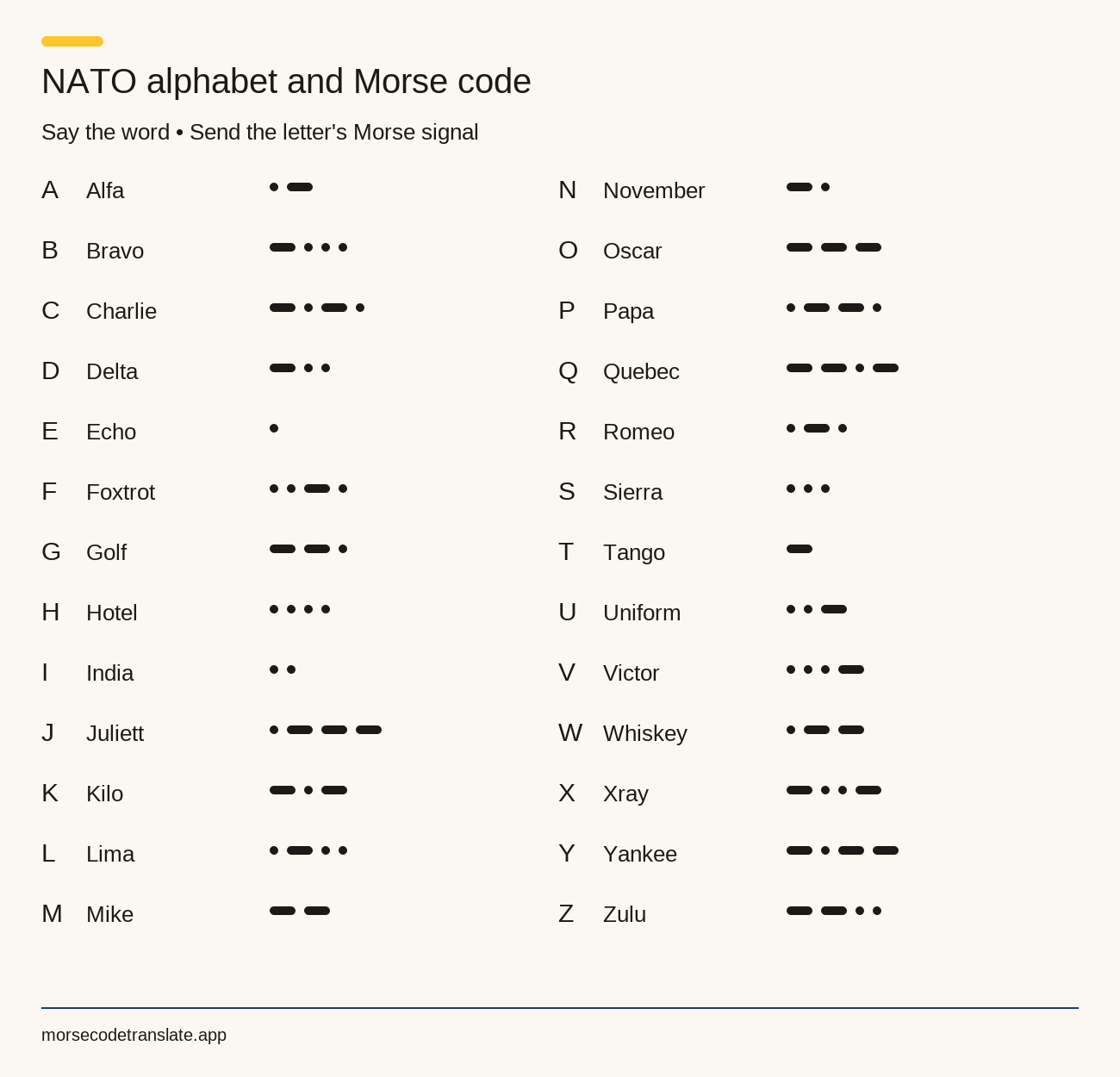
Open the chart to print or save it
For example, the letter group CAT becomes Charlie Alfa Tango. To turn it back into letters, write the initial of each word, in order. Do not write out the whole words as the message: Charlie represents C. This is a worked example using the chart above (NATO alphabet cards).
How do you pronounce the NATO phonetic alphabet?
Use the pronunciation hints on NATO's official poster: for example, Alfa is “al-fah”, Juliett is “jew-lee-ett” and Quebec is “keh-beck”. The poster's transcriptions are based on English pronunciation (NATO, 2018, pronunciation note and alphabet cards).
Keep the NATO pronunciation poster beside the chart when you practice. The chart gives you the written code word; the poster adds a guide to saying it. ICAO describes its pronunciations as approximate and notes that speakers' language habits can affect how they say the words (ICAO, pronunciation guidance).
Why ALFA and JULIETT have those spellings
Alfa uses an F because speakers of some languages may not recognize PH as the F sound. Juliett has a double T so French speakers will pronounce its final consonant rather than treat it as silent. These spellings help the words travel between languages (ICAO, paragraph beginning ‘In the official version’).
Keep those spellings when copying the chart. If you are writing an ordinary sentence about a person named Juliet, keep that person's actual name. The special spelling belongs to the code word representing J. For practice, the initials AJ become Alfa Juliett; the message still contains only the letters A and J.
Is this the phonetic alphabet the military uses?
Yes. NATO uses it to reduce spelling mistakes when people with different accents communicate. It assigns a recognizable word to each letter (NATO, Phonetic alphabet section). It also serves civilian communication: ICAO describes using a spelling alphabet over radio or telephone, particularly when a letter group must be understood clearly (ICAO, ICAO Spelling Alphabet section).
Imagine that you need to give someone the letters B and D. Instead of repeating the letter names, look up each row and say Bravo Delta. Have the other person write down the initials and read them back. This exercise uses the words as a shared key: both people need the same letter-to-word mapping.
Why were these code words chosen?
Radio spelling words must remain understandable across languages and through imperfect reception. ICAO describes testing sounds, words and alphabets, then choosing words that were easy to pronounce and recognize and could be transmitted clearly by radio. Later testing addressed words that listeners confused under poor receiving conditions (ICAO, selection criteria and subsequent testing paragraphs).
That explains why making up a new word for a letter can defeat the purpose. In a chart exercise, keep November for N even if a shorter word comes to mind. The listener should be able to use the same row as the speaker. Practice with your own initials, then swap roles and check the written letters against the original.
Who created the NATO phonetic alphabet, and when?
It was developed for civil aviation, not by NATO. ICAO says that in 1948 and 1949 Professor Jean-Paul Vinay of the Université de Montréal worked with its Language Section on a single alphabet, and that the new alphabet was set for implementation in civil aviation on 1 November 1951(ICAO, history of the spelling alphabet). Tests with speakers from 31 countries led to five replacements: Charlie, Mike, November, Uniform and X-Ray. The final version took effect on 1 March 1956, and NATO, the ITU and the International Maritime Organization adopted it (ICAO, 1952 re-examination and 1956 version). NATO itself says the alphabet “became effective in 1956” (NATO, Phonetic alphabet section).
Earlier alphabets existed. ICAO lists the Allied “Able/Baker” alphabet of World War II, which civil aviation also used for a time, and an ITU alphabet from 1927 for ships (ICAO, early alphabets). The name used by ICAO is the International Radiotelephony Spelling Alphabet.
How do you say numbers with the NATO alphabet?
Say each digit on its own. ICAO notes that in most cases each number is sent one digit at a time, and that three is said “tree”, five “fife” and nine “niner” (ICAO, numbers). So 359 is “tree fife niner”. For altitudes, cloud heights, visibility and runway visual range, whole hundreds and thousands use the word HUNDRED or THOUSAND after the digit (ICAO, hundreds and thousands). A letter and a digit can be mixed: B9 is “Bravo niner”.
Morse code has its own digits, separate from these spoken words; see Morse code numbers. Radio navigation aids that still identify themselves in Morse are covered in Morse code in aviation.
NATO phonetic alphabet code versus Morse code
These systems carry letters differently. The spelling alphabet uses spoken words. Morse uses on-off tones, flashes or clicks (NATO, Phonetic alphabet and International Morse Code sections). For A, you can say Alfa or send . Those are two ways of representing A; saying Alfa does not mean sending all the Morse letters in ALFA.
The player below sends CAT in Morse. Compare its letter groups with the chart: C, then A, then T. It does not speak the spelling words. The character patterns come from the same international table as the Morse column (ITU, Annex 1, section 1.1.1).
The Morse code alphabet includes the signal patterns. If you are reading a written message, how to read Morse code explains its letter and word boundaries. For recognition by sound, start with learning Morse code by ear.
NATO phonetic alphabet translator: use the chart
To translate a short name into spelling words, write its letters on separate lines and find each row. For SAM, the result is Sierra Alfa Mike. To decode those words, take their initials. Keep spaces between separate names in your written notes so you can see where each name ends.
For Morse output, enter the original letters in the Morse code translator. Enter SAM to get that name's signal groups. Entering Sierra Alfa Mike would instead ask it to encode the full words, giving a different message. Check the input text before comparing the result with the Morse column.
NATO phonetic alphabet PDF: print this page
To make a paper reference or save a copy, open your browser's print command. In Chrome, use Ctrl+P on Windows or Linux, or Command+P on a Mac. Choose a destination and inspect the preview. To keep a file, pick Save as PDF if your browser lists it (Google Chrome Help, printing and Save as PDF steps).
Choose the preview pages containing the alphabet chart if you only need the reference table. Check the first and last rows before printing so Alfa and Zulu are both included. Leave enough room beside your copy to write a practice name and its matching code words.
Sources
- NATO phonetic alphabet, codes and signals. NATO, 21 December 2017.
- NATO phonetic alphabet, codes & signals poster. NATO Communications Services, Public Diplomacy Division, 2018.
- Annex 10 — Aeronautical Telecommunications: ICAO spelling alphabet. International Civil Aviation Organization, checked 9 November 2026.
- Recommendation ITU-R M.1677-1, International Morse code. ITU Radiocommunication Sector, October 2009.
- Print from Chrome — Computer. Google Chrome Help, checked 9 November 2026.