
- Translator
- Parasite Morse code
Parasite Morse code messages
Spoilers: Parasite (2019) uses a basement-controlled light for Geun-se’s thanks and plea for help, then Ki-taek’s letter to his son. Ki-woo decodes the final signal and learns where his father is hiding.
Spoilers: this guide reveals the hidden basement and the ending of Parasite (2019) (Criterion, film information).
The house lights carry different messages. Geun-se uses them to thank Mr. Park and later ask for help. At the end, Ki-taek uses the same connection to reach his son, Ki-woo. The sender changes; the basement-controlled light remains the channel (Schubert and Dhanushka, p. 80).
Who sends the Morse code in Parasite?
Geun-se, the husband of the former housekeeper, Moon-gwang, sends the early light messages. He is living below the Park home. His messages first express gratitude to the man whose household sustains him. Later, the signal becomes a plea for help, noticed by the Parks’ son, Da-song. Yeon-gyo also notices the light but treats its behavior as a faulty sensor (Polity, pp. 77 and 80).
Fitria's abstract identifies the intended English plea as HELP and says it is misread as HOLP (Fitria, 2021, abstract). That distinction matters: a transmitted request and a receiver's interpretation can differ. This is the earlier message involving Da-song; the ending has Ki-taek addressing Ki-woo (Polity, p. 80).
How do the lights send a message?
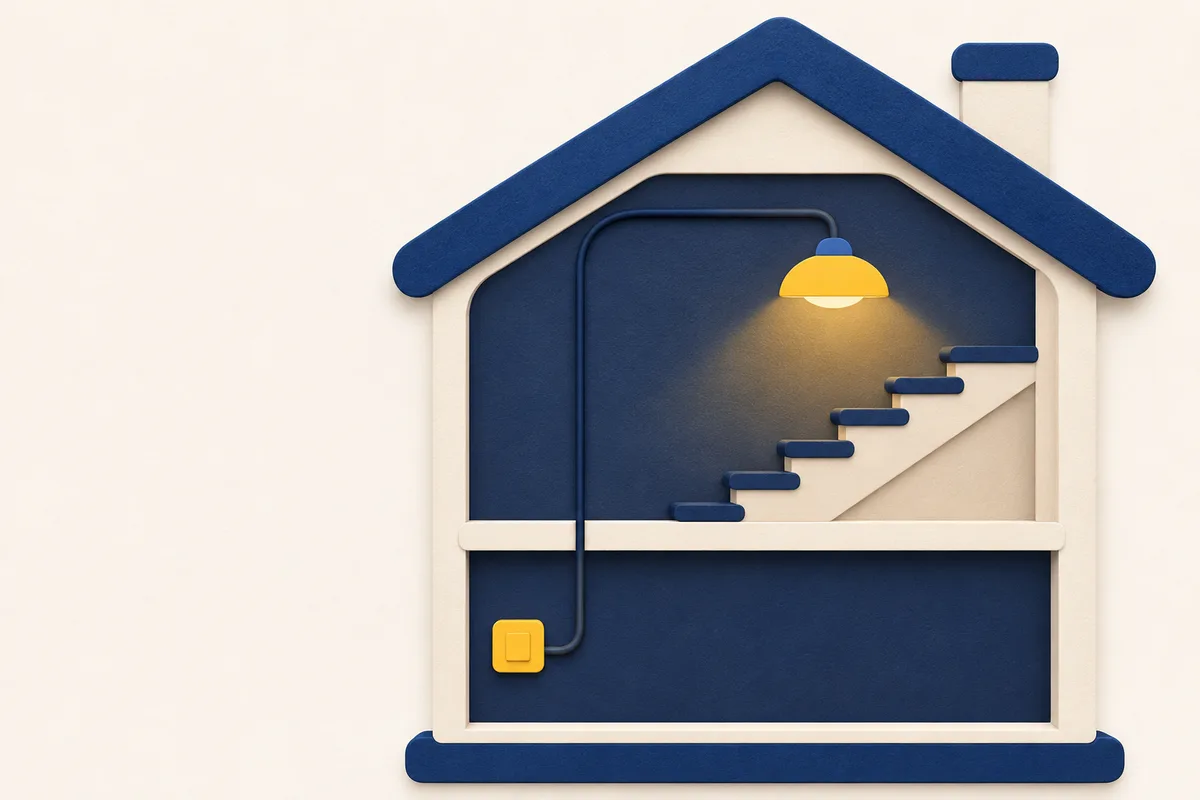
The reveal is that a person below the house can operate the light above. What looks like an automatic convenience depends on Geun-se’s hidden work. The same control lets him send a deliberate pattern instead of simply illuminating the stairs (Polity, p. 80).
For a Morse reader, the useful distinction is between a brief signal, a sustained signal and the pauses around them. The international standard assigns patterns to characters and defines the gaps that separate their parts (ITU-R M.1677-1, Annex 1, sections 1–2). A lamp can make those patterns visible. It does not need to display written letters.
That gives you a practical way to watch the scene: separate seeing a flicker from recognizing a message. A visible event is only the beginning. You still need to identify the signal lengths, keep their boundaries and know which alphabet to use. The guide to Morse code with a flashlight uses the same sending idea in a practice setting.
What does the Morse code at the end say?
Ki-woo sees a light flashing at the house and decodes it. He learns that his missing father is alive and living in the basement (Yonhap, 2020).
The final signal is Ki-taek's account of his life in the basement, addressed to Ki-woo. Polity describes him telling his story through the light, and Yonhap confirms that Ki-woo decodes the signal and learns that his father is alive and hiding there (Polity, p. 80), (Yonhap, 2020). This is the meaning of the ending's message, rather than a flash-by-flash transcript.
Read the ending’s communication in layers: the lamp provides the visible signal, Morse provides the encoding, and the letter provides the meaning. Knowing that someone is alive is different from having a way to bring him out. Decoding answers the first question; it does not by itself solve the second.
Hear HELP as an English practice message
The player below encodes HELP, the intended plea identified in Fitria’s study (Fitria, 2021, abstract). It is an English rendering for practice, not a reconstruction of the film’s light pulses or the father’s full letter.
The film is in Korean (Criterion, film information). An English subtitle tells you a message’s meaning; encoding that translation does not establish the original signal. This site’s translator does not convert Korean writing, so do not paste a Korean subtitle into it and treat the result as a verified decoding.
| Letter | Signal | Read aloud |
|---|---|---|
| H | dot dot dot dot | |
| E | dot | |
| L | dot dash dot dot | |
| P | dot dash dash dot |
Use the Morse code alphabet to check each character. Then enter HELP in the Morse code translator and compare the grouped text with the player. If you want to recognize the rhythms without looking at the table, start with learning Morse code by ear.
How can you check a light message yourself?
Work from a copy of the scene you can pause. Keep your first transcription separate from the meaning you expect to find. Otherwise, it is easy to turn an uncertain flash into the letter you wanted.
- Pick one visible light. Follow that light consistently rather than mixing changes elsewhere in the frame into your notes.
- Record the sequence before translating. Mark each visible signal as short, long or uncertain. Preserve the gaps.
- Keep the evidence of a cut. If the shot changes during a signal, mark the interruption. Do not silently join the two shots into a complete character.
- Choose the alphabet before assigning letters. A translation in the subtitles is not a substitute for that choice.
- Check the result against another uninterrupted passage. Leave an unclear group unresolved instead of forcing a familiar word.
The video decoding guide develops that recording method. For ordinary International Morse practice, Morse code timing helps you distinguish a pause inside a character from one between characters.
Where did Bong Joon Ho get the ending’s idea?
Yonhap reports that a blinking traffic light in Vancouver inspired the final scene (Yonhap, 11 February 2020).
At the Walker Art Center, Bong explained that the hidden basement family and much of the second half took shape late in his writing. The letter and Morse epilogue arrived in his final month of screenwriting. He described the third family as essential to the film even though that idea came late (Walker dialogue, PDF pp. 23–24).
Those comments establish the scene’s creative origin without requiring a theory about every flickering light. For other examples, Morse code in movies and music brings together stories in which a signal’s role matters as much as its decoded text.
Sources
- Landscapes of Crossed Lines: Bong Joon Ho’s Parasite, Andi Schubert and Shashik Dhanushka, page 80. Polity, Volume 8, Issue 1 & 2, checked 11 November 2026.
- Representation of Symbols in Parasite Movie, Tira Nur Fitria. ISLLAC, Universitas Negeri Malang, checked 11 November 2026.
- Bong Joon-ho maps out two-family satire of Parasite in 2013, Kim Boram. Yonhap News Agency, 11 February 2020.
- Bong Joon Ho in dialogue with Scott Foundas, transcript, pages 23–24. Walker Art Center, 12 February 2020.
- Parasite (2019), film information and credits. The Criterion Collection, checked 11 November 2026.
- Recommendation ITU-R M.1677-1, International Morse code. ITU Radiocommunication Sector, October 2009.