
- Translator
- Disneyland Morse code
Disneyland Morse code: the message
A Disney press account republished in 2015 says the New Orleans Square train station telegraph sent a shortened version of Walt Disney's 1955 dedication. Its opening welcomes visitors to Disneyland (Disneyland Resort PR, republished by The Main Street Mouse).
The documented message starts, “To all who come to Disneyland, welcome.” (Disneyland Resort PR, republished 21 July 2015) This short excerpt is enough for a first listening exercise. Keep the published message separate from the question of present playback.
What does the Morse code at Disneyland say?
After the welcome, the documented message contrasts older visitors remembering earlier times with younger visitors looking toward future possibilities. It draws on the dedication Walt Disney gave on 17 July 1955. The press account calls the telegraph text a paraphrased portion of that speech (Swanson, 2015).
You can therefore identify the message without treating a full dedication transcript as a station transcript. The welcome is a useful short excerpt to recognize. The remaining thought is about the relationship between generations, memory and possibility. Read it as a welcome rather than looking for train instructions in the text.
For the dedication itself, Disney's illustrated opening-day account reproduces the plaque and explains that Walt read its words at the official dedication (Disney Parks Blog, 2024). Use that resource to compare the speech with the shortened telegraph version, rather than assuming they match word for word.
Which Disneyland train station has this message?
The named location in the 2015 account is New Orleans Square, specifically its telegraph cable office (Swanson, 2015). Keep that location attached to the transcript. A search for “Disneyland train station Morse code” can lose the station name, but this source does not assign the message to Main Street.
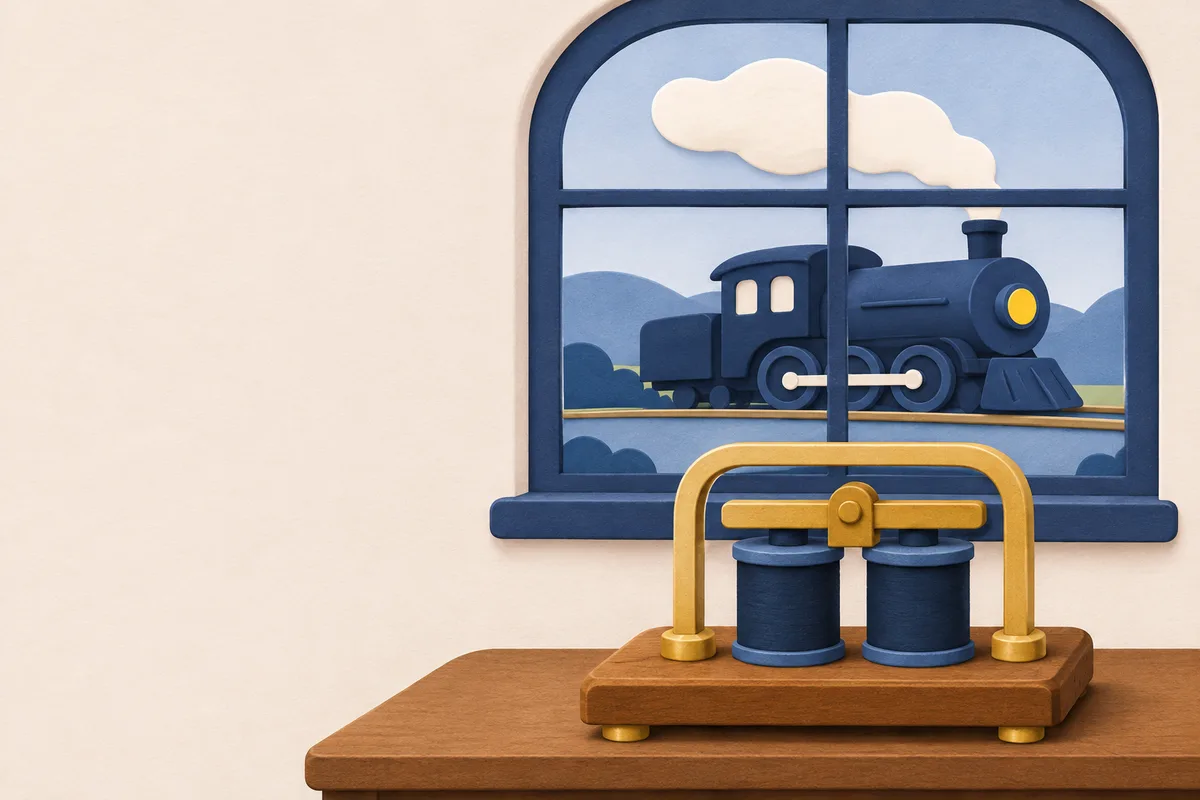
Railroad historian Steve DeGaetano's station history supplies an independent matching transcript. He describes the older Frontierland station building being moved across the tracks during the changes associated with New Orleans Square. His account uses the Frontierland name while explaining the sound effect and its abbreviated message (Steve DeGaetano, MiceAge).
That history helps you read older descriptions without shifting the message to a different station. When checking a recording, keep its stated location and recording date beside your notes. A title that says only Disneyland gives you less evidence than one that identifies the station and shows where the sound was captured.
Hear the confirmed welcome excerpt
The player below renders only the short welcome quoted above. It uses International Morse for practice, following the ITU's letter and punctuation table (ITU-R M.1677-1, Annex 1). This is generated audio, not the park recording, and it does not recreate a mechanical telegraph sounder.
Try a listening exercise before attempting an entire recording:
- Read the welcome once, then listen without following the printed words.
- Choose a short word from the excerpt and enter it in the Morse code translator.
- Use the International Morse alphabet chart to check letters you could not identify.
- Return to the excerpt and write down what you recognize. Leave uncertain letters blank rather than filling them from the sentence you expect.
This exercise practices recognition with known text. To transcribe unfamiliar audio, first let the sound establish the letters; then compare your result with the published account. Learning Morse by ear gives you a starting point for that practice.
Why does a telegraph click instead of beep?
A mechanical sounder turns changes in electric current into movements of a metal arm. The Science Museum Group explains that an electromagnet pulls the arm down when current flows; the arm springs back when it stops. The interval between those movements communicates the short or long signal (Science Museum Group).
That makes a sounder different from the clean tone in this page's player. In the museum's explanation, you listen to the timing between the mechanical sounds. Avoid treating every click as a complete letter. A useful first question is whether the audio you are studying contains sustained tones or the movements of an instrument (Science Museum Group).
For the electrical system behind the instrument, read how the telegraph worked. DeGaetano describes the station effect as a recording of a sounder. His history also recounts a transition from an endless-loop tape machine to digital playback (Steve DeGaetano, MiceAge). A sound associated with a telegraph display need not mean someone is sending a new live message.
Is the station recording American Morse?
The republished Disney press account confirms Morse and supplies the text, but does not name the alphabet variant (Swanson, republished in 2015). DeGaetano says the station code differed from the Continental or International code familiar to the listener who investigated it (Steve DeGaetano, MiceAge).
The practice player is explicitly International Morse. Do not use it as proof of the station's character patterns. Compare American and International Morse code before choosing a chart for a historical recording.
Does the Disneyland telegraph still play today?
The account cited here was republished on 21 July 2015 (The Main Street Mouse, 2015). It preserves the message and location, but it is not a current operating notice.
For another documented message with a different historical setting, see famous Morse code messages. What hath God wrought offers a separate example to compare with the park's commemorative use. When sharing the Disneyland answer, retain the station name, the shortened-text qualification and the date of the published account.
Sources
- Sounding Off at the New Orleans Square Train Station Telegraph Cable Office at Disneyland Park. The Main Street Mouse, republishing an account credited to Shannon Swanson, Disneyland Resort PR, 21 July 2015.
- Station Story (continued). Steve DeGaetano, MiceAge, 2008 copyright; checked 20 November 2026.
- A Look Back at July 17, 1955, Opening Day at Disneyland. Disney Parks Blog, 17 July 2024.
- Morse sounder, 1835–1910. Science Museum Group, checked 20 November 2026.
- Recommendation ITU-R M.1677-1, International Morse code. ITU Radiocommunication Sector, October 2009.