
- Translator
- What hath God wrought
What hath God wrought?
“What hath God wrought” is the message Samuel Morse sent from the Capitol to Baltimore on 24 May 1844. Annie Ellsworth chose the words from Numbers 23:23, and Alfred Vail sent them back along the wire.
In short: Samuel Morse sent “What hath God wrought” on 24 May 1844 over the new line from the Capitol to Baltimore. The words were chosen by Annie Ellsworth, the patent commissioner's daughter, and come from Numbers 23:23. Alfred Vail, at the Baltimore end, sent the same words back. Historians disagree on one point: which room in the Capitol Morse sat in.
Who chose the words?
Not Morse. According to the Senate Historical Office, he invited Annie Ellsworth, the daughter of the Commissioner of Patents, to compose the first message in front of a small group of guests. She picked a line from the Bible (Senate Historical Office, 2024). Her father, Henry L. Ellsworth, was a friend and Yale classmate of Morse, and years earlier had given him a caveat, a document that preserved his claim to the invention while he prepared a patent application (Senate Historical Office, 2024). The Library of Congress holds the paper tape. Across its top, Morse credited Annie for suggesting the message (Library of Congress).
What does it mean?
The old forms are plain English once you translate them. “Hath” is the archaic third-person singular of “have” (Dictionary.com), and “wrought” is an archaic past tense of “work” (Dictionary.com). Read in modern English, the question is what God has worked, or brought about.
The line is Numbers 23:23, which reads “What hath God wrought!” in the King James text, closing a verse that begins “Surely there is no enchantment against Jacob” (King James Version, Project Gutenberg). The scene is set earlier in the chapter: Balak had taken Balaam to curse the people of Israel, and complains that Balaam has “blessed them altogether” (King James Version, Project Gutenberg). In the Bible the line is an exclamation. The Library of Congress writes the telegraph message with a question mark (Library of Congress).
Which room was Morse in?
Here the sources disagree. The Library of Congress says Morse sent the message from the Supreme Court room in the Capitol, and the Smithsonian says only “in the Capitol” (Library of Congress) (Smithsonian). The Senate Historical Office says that accounts placing it in the Old Supreme Court Chamber came decades later, and that a plaque outside the chamber went up in 1944 for the centenary. Researchers have found no documentation that Morse left the room in the Senate wing where he had set up his equipment, so that room is the most likely source (Senate Historical Office, 2024). The Smithsonian Institution Archives has yet another version, with the reply arriving in the Capitol Rotunda (Smithsonian Institution Archives, 2011). We follow the Senate historians: the building is certain, the room is not.
The setting was small. By the Senate's account, the 24 May demonstration was a private event and attracted little press attention (Senate Historical Office, 2024). Sources differ on how long the wire between Washington and the railroad depot in Baltimore was that day. The Senate Historical Office gives 38 miles (Senate Historical Office, 2024), and the Smithsonian describes a forty-mile line (Smithsonian).
What did the tape look like?
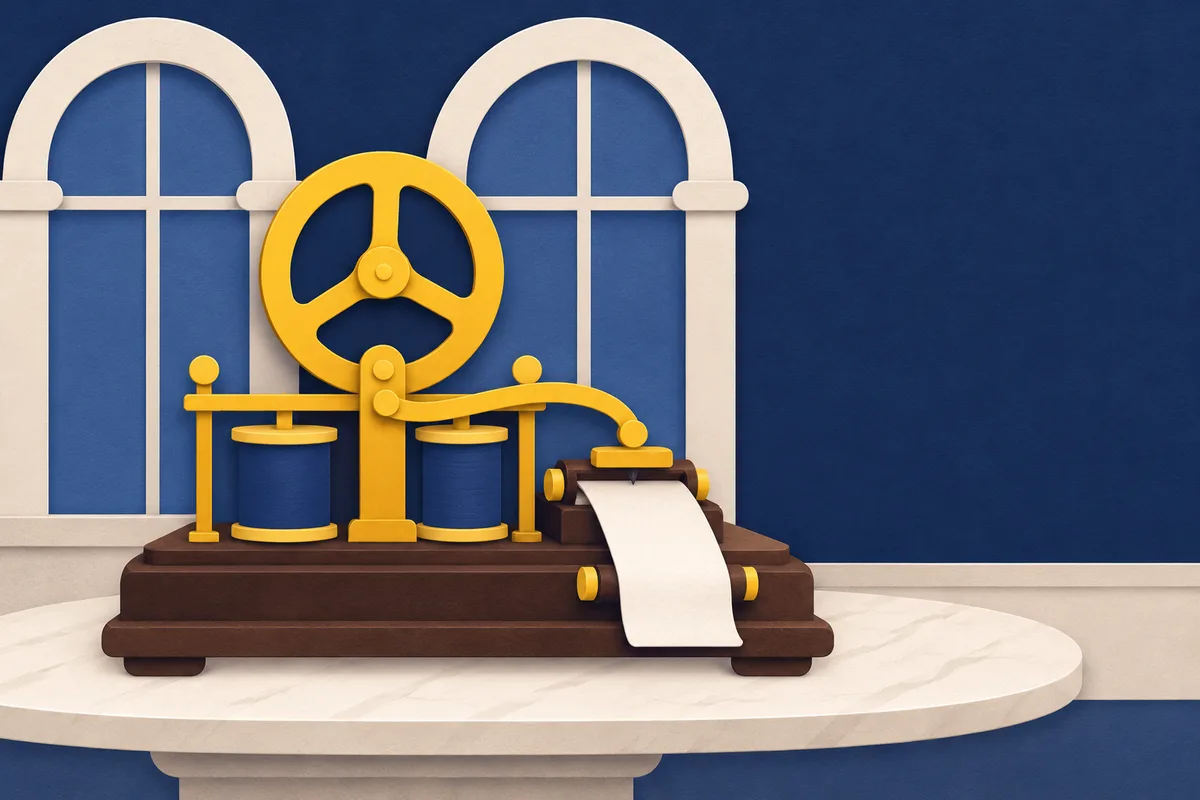
Morse's early system embossed raised dots and dashes on a paper strip, which an operator translated afterward (Library of Congress). Alfred Vail described the same method in his 1845 book: hard steel points that indent the paper against a grooved roller, “raising the surface, as in the printing for the blind.” His first working model had used a lead pencil, and a pen with ink had been tried before the embossing points (Vail, 1845).
Two paper records survive in two institutions. The Library of Congress holds Morse's own strip. The Smithsonian holds a tape described as Vail's return message from Baltimore, “confirming what was received”; its label says Morse transcribed it himself, and the strip is 70.5 centimeters long (27¾ inches) (Smithsonian). The Linda Hall Library, by contrast, says that tape recorded the first message at Baltimore (Linda Hall Library). The Senate historians put it briefly: “Moments later,” an identical message came back from Vail (Senate Historical Office, 2024).
That note matters. In Vail's 1845 table, a single long line stands for L, where International Morse sends four signals for it (Vail, 1845) (ITU-R M.1677-1, Annex 1, section 1.1.1). The letter signs in the drawing of Morse's own 1848 patent are fewer than the letters, so some letters share one (US Reissue RE117). The words on the tape were the same; the letters were spelled in the code of 1844. American vs International Morse sets out the differences.
Was it the first message, and what came next?
No, not by any count. Morse had sent a signal over 10 miles of spooled wire in 1837 and over 33 miles in New York before Congress paid for the Baltimore line (Senate Historical Office, 2024). Even on this line, 24 May was not the first public test. On 1 May 1844 Vail, working from a station at Annapolis, 22 miles from Washington, intercepted news of the Whig convention in Baltimore, which was being carried by train, and telegraphed it to the Capitol an hour before the train arrived (Senate Historical Office, 2024). Congress had voted the $30,000 on 3 March 1843 for a test line to Baltimore (Library of Congress).
The public learned what the wire could do days after the message, when Vail sent minute-by-minute news of the Democratic convention and the nomination of James K. Polk. A crowd of hundreds, perhaps a thousand, waited outside the Capitol for the result (Senate Historical Office, 2024). Congress did not buy the invention. It paid $8,000 to keep the line running for a year under the Post Office, and in 1847 the Post Office leased it to private investors (Senate Historical Office, 2024).
How old was Annie Ellsworth?
Sixteen, according to the U.S. Capitol Visitor Center. Its handout says she suggested the words “to express amazement at the invention” (U.S. Capitol Visitor Center).
Where did the line run, and where was it received?
The line followed a railroad. The National Museum of Railroad History & Innovation, which runs the Mt. Clare Station site, says Congress gave Morse $30,000 in 1843 for a line between Washington and Baltimore “along the right-of-way of the Baltimore and Ohio Railroad” (National Museum of Railroad History & Innovation). That fits the Senate account of a wire ending at the railroad depot in Baltimore. None of the sources we opened names the receiving building more exactly, so we do not.
The museum's page also names the “old Supreme Court Chamber” for the Capitol end (National Museum of Railroad History & Innovation), the account the Senate historians say dates from decades later. The Visitor Center handout says only that the message went “from the U.S. Capitol” (U.S. Capitol Visitor Center). The museum's page is about its Mount Clare Station, which dates from 1851, seven years after the message (National Museum of Railroad History & Innovation).
What was the first message across the Atlantic?
“Europe and America are united by telegraphic communication.” The IET Archives give that as the first official message on the transatlantic cable, sent on 16 August 1858 (IET Archives). That is 14 years after the Baltimore line, and it came over a submarine cable, not the Capitol wire. The transatlantic telegraph cable tells how that cable was laid and why it failed.
How do the words look in Morse code, letter by letter?
The message has 4 words and 18 letters. The tiles below show each letter with its International Morse code, in the order the operator sent them. The note under the player above explains why the 1844 tape itself looked different.
- W
- H
- A
- T
- H
- A
- T
- H
- G
- O
- D
- W
- R
- O
- U
- G
- H
- T
The Pony Express and the telegraph compares the wire with the Pony Express.
For how the key, the wire and the paper register worked together, read How the telegraph worked. For the people behind the experiment, see Who invented Morse code? and Alfred Vail. You can also type any phrase into the translator to hear it, or start with the Morse code alphabet.
Sources
- “What Hath God Wrought”: Morse’s Telegraph in the Capitol, Senate Stories. U.S. Senate Historical Office, 7 May 2024; read in the Wayback Machine copy of 2 October 2026.
- First telegraphic message, 24 May 1844 (paper tape). Library of Congress, Samuel F. B. Morse Papers, 24 May 1844.
- “What Hath God Wrought” Telegraph Message (object EM*001028). Smithsonian National Museum of American History, checked 7 November 2026.
- A Forgotten History: Alfred Vail and Samuel Morse, by Courtney Bellizzi. Smithsonian Institution Archives, 24 May 2011; read in the Wayback Machine copy of 12 January 2026.
- Alfred Vail, Description of the American Electro Magnetic Telegraph, Washington: J. & G. S. Gideon. University of Illinois copy at the Internet Archive, 1845.
- The King James Version of the Bible, Numbers 23. Project Gutenberg, eBook #10, last updated 6 April 2024; checked 7 November 2026.
- hath. Dictionary.com, checked 7 November 2026.
- wrought. Dictionary.com, checked 7 November 2026.
- Timeline 1840–1872, Samuel F. B. Morse Papers at the Library of Congress. Library of Congress, Manuscript Division, checked 6 November 2026.
- S. F. B. Morse, US Reissue Patent RE117: Improvement in electro-magnetic telegraphs (text and drawing sheet 1). United States Patent Office, via Google Patents, 13 June 1848.
- Scientist of the Day: Alfred Vail, by William B. Ashworth, Jr.. Linda Hall Library, checked 6 November 2026.
- Recommendation ITU-R M.1677-1, International Morse code. ITU Radiocommunication Sector, October 2009.
- Mt. Clare Station (1851), collection page. National Museum of Railroad History & Innovation, checked 11 November 2026.
- When was the first telegraph sent? Make a Telegraph (handout CVC #21-036). U.S. Capitol Visitor Center, checked 11 November 2026.
- The first transatlantic telegraph cable 1858. The IET Archives (Institution of Engineering and Technology), checked 7 November 2026.