
- Translator
- Monte Cristo telegraph
The Monte Cristo telegraph explained
The telegraph in The Count of Monte Cristo is an optical Chappe system. Operators relay the positions of mechanical arms; it does not use electric Morse code (Dumas, chapter 60), (FNARH, Chappe history).
What is the telegraph tower in Monte Cristo?
The tower carries an optical Chappe telegraph, whose mechanical-arm positions are relayed between stations (Smithsonian, The Chappe Semaphore). In chapter 60, the Count describes black arms on a hill and an operator watching a neighboring station. Villefort directs him toward the tower at Montlhéry (Dumas, chapter 60, PDF pp. 12–14).

Start your reading with a practical question: what must the next station be able to see? Operators used telescopes to observe neighboring towers. Mechanical-arm positions indicated numbers associated with words. A visible arrangement supplied a signal that could be copied farther along the line (Smithsonian, The Chappe Semaphore).
That gives you a useful way to read the machinery before following the plot. Look for the distant station, the person observing it, and the controls used to reproduce its signals. Keep the apparatus separate from the message it carries.
What happens in the telegraph episode?
Spoilers for chapters 60 and 61 of the novel. In chapter 61, the Count pays the Montlhéry operator 25,000 francs to replace the incoming transmission with three signs supplied on a piece of paper. The operator is a passionate gardener. The next station repeats the altered signals, which reach the minister (Dumas, chapter 61).
The false report says that Don Carlos has escaped from Bourges and returned to Spain. Debray warns Madame Danglars, who tells her husband. Danglars sells his Spanish securities, and their value falls. A correction the next morning denies the report and attributes the error to fog. The market recovers after his sale (Dumas, chapter 61).
Read the sequence as a chain: an altered signal becomes official news, the news reaches a trader, and a sale follows. This is an interpretation of the episode's structure. The Count's intervention works through the people who trust and act on the dispatch.
How did the real Chappe telegraph work?
The historical network moved information by observation and repetition. FNARH's account describes a long pivoting arm with shorter movable arms at its ends. Operators controlled the mechanism from inside the station through ropes and pulleys. Telescopes let them read the neighboring apparatus (FNARH, apparatus and telescopes).
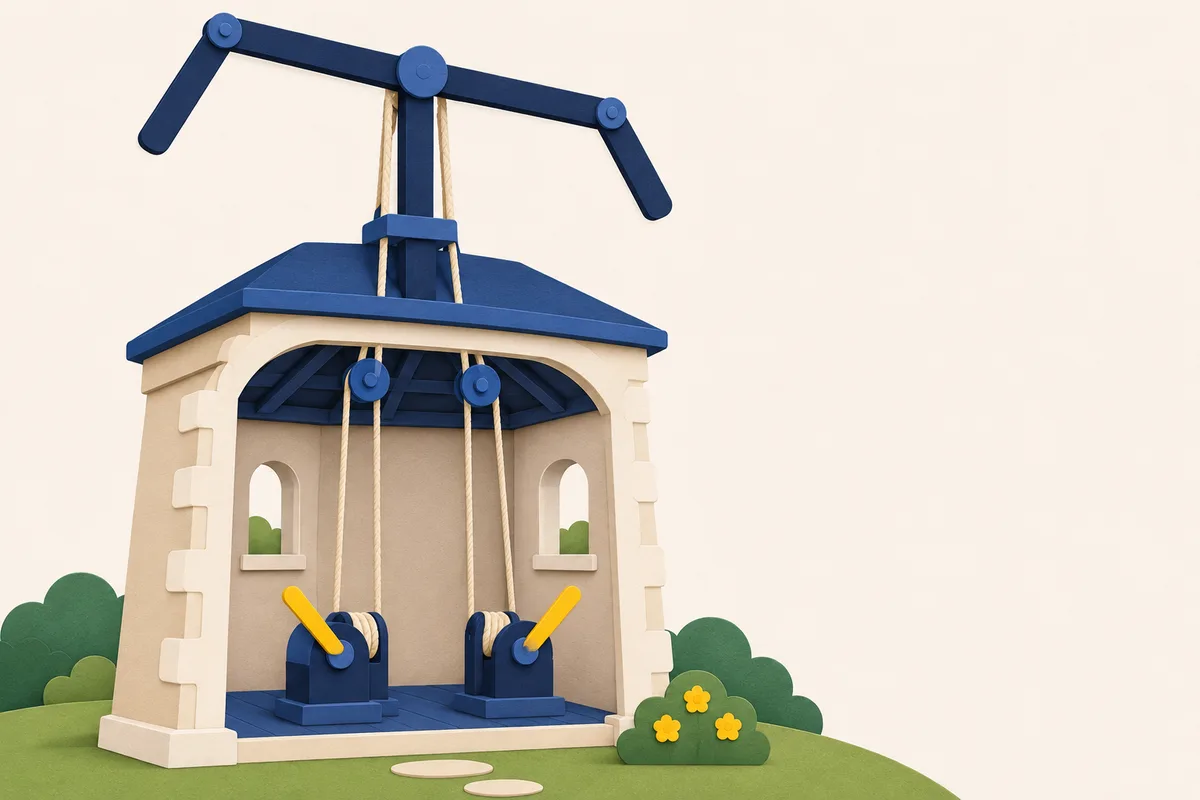
- Form a visible position. The station's mechanism places its arms in the required arrangement.
- Observe the neighboring station. A telescope makes the distant position readable.
- Repeat the signal. The next station reproduces it for the following observer.
This outline simplifies the tower relay described by the Smithsonian (Smithsonian Libraries).
Visibility was essential. Darkness and bad weather made the system largely unusable, according to the Smithsonian (Smithsonian, visibility limits).
Did each operator understand the message?
Dumas's operator says he does not understand the dispatch signals he repeats, while recognizing routine instructions about his own work (Dumas, chapter 61). The distinction has a historical counterpart. FNARH explains that directors held the vocabulary and were authorized to encode and decode dispatches (FNARH, Les directeurs).
In the vocabulary FNARH describes, a transmitted number identified a page and another identified a line. Together they selected a word or prepared phrase. Copying the visible numbers was therefore a different task from recovering the words (FNARH, Le vocabulaire).
For your reading notes, separate three jobs: making a signal, relaying it and interpreting its meaning. You can then ask which job the Count interferes with. Avoid treating every movement as a letter. The history describes a vocabulary system, so a letter-by-letter Morse translation would answer a different question.
Where can you see what the machine looked like?
The Rijksmuseum's optical telegraph model gives you a collection object to examine. The catalog dates it to 1792–1795 and identifies it as a demonstration and instruction model after Claude Chappe's design. Its main arm turns between two supports, and the wings at its ends turn separately (Rijksmuseum).
Inspect the lower controls as well as the outline above them. The museum describes drawbars and chains transferring movement from the controls to the arms. This is a model of a mechanical relationship you can trace with your eyes. Do not assume every detail of that particular model appears in the novel's tower (Rijksmuseum).
The Smithsonian's Chappe semaphore exhibit includes a semaphore illustration, historical documents and a map of French routes.
Was the Monte Cristo telegraph Morse code?
No. Compare the visible arm positions above with International Morse, which assigns short and long signals to written characters. ITU-R M.1677-1 defines the Morse characters and their spacing (ITU, Annex 1, Part I).
The following player spells TOWER in International Morse. It is a related listening exercise, not Chappe encoding and not the Count's altered message. Its letter patterns follow the ITU alphabet (ITU, Annex 1, letter table).
Play the word and check its letters against the International Morse alphabet chart. Try another short word in the Morse code translator, or begin the Morse listening lessons if you want to learn the sound patterns.
For further reading, distinguish the message from the telegraph system and compare electrical telegraph operation with the visual relay here. The semaphore alphabet guide covers another signaling system with its own character positions. For questions about transmission time, see how telegraph speed depended on the system.
Sources
- The Count of Monte Cristo, Chapter 60: Telegraph. Alexandre Dumas; Lit2Go, University of South Florida, checked 11 November 2026.
- The Count of Monte Cristo, Chapter 61: How a Gardener May Get Rid of the Dormice. Alexandre Dumas; Lit2Go, University of South Florida, checked 11 November 2026.
- The Chappe Semaphore, The Underwater Web: Cabling the Seas. Smithsonian Institution Libraries, checked 11 November 2026.
- Le télégraphe aérien de Claude Chappe, historical account by Paul Charbon. FNARH, French postal and telecommunications historical associations, checked 11 November 2026.
- Model of an optical telegraph, object NG-MC-810. Rijksmuseum, checked 11 November 2026.
- Recommendation ITU-R M.1677-1, International Morse code. ITU Radiocommunication Sector, October 2009.