
- Translator
- Practice oscillator
How a Morse code practice oscillator works
A Morse code practice oscillator is a battery, a key, a tone circuit and a speaker: press the key and it beeps. ARRL's design uses a 555 timer chip and a 9-volt battery that is drawn on only while the key is down. This guide explains how it works and how to practice with it.
In short: a practice oscillator is a battery, a key, a tone circuit and a speaker. Press the key and it beeps; release it and it stops. In ARRL's design the circuit draws power only while the key is down, so it needs no on-off switch (ARRL, Now You're Talking, 1990). You use it to practice sending Morse.
What a practice oscillator is
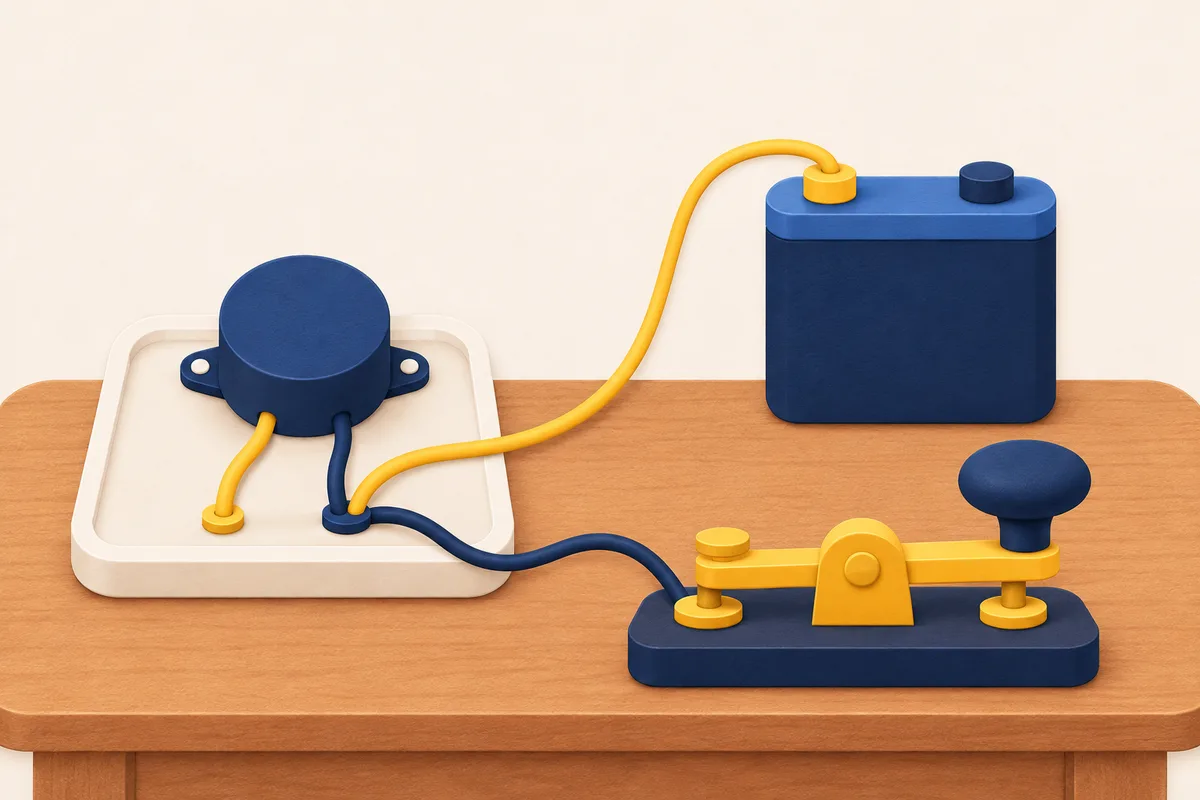
It is the simplest Morse sounder you can build. A Morse key is a switch; on its own it makes no sound. A practice oscillator adds what the key needs to be heard: a battery, a circuit that makes a steady tone and a speaker. It sends nothing anywhere: it is just a box that beeps while you hold the key down.
The chain is the "battery, key, buzzer" idea in its smallest form. In ARRL's version, pressing the key connects a 9-volt battery to a 555 timer chip. The chip converts the battery's direct current into the alternating current you hear as a tone in the speaker (ARRL, How It Works, 2010).
| Part | What it does |
|---|---|
| 9-volt battery | The only power source |
| Key | A switch: pressing it connects the battery to the circuit |
| 555 timer chip | The oscillator: turns the battery's steady current into the tone |
| Resistors and a small capacitor | Set the speed at which the chip switches, which is the pitch |
| 100-kilohm potentiometer | A variable resistor: your pitch knob |
| Small speaker | Plays the tone; ARRL's build uses 8 ohms, with a small resistor and capacitor between the chip and the speaker to soften the sound |
How the circuit sets the pitch
The 555 chip switches on and off over and over. A capacitor charges and discharges through the resistors, and the rate at which it does so sets the pitch; you change that rate with the variable resistor. A higher resistance gives a lower pitch (ARRL, How It Works, 2010). The chip's output is a square wave, which sounds raspy in a speaker, so a resistor and a capacitor (R5 and C3 in ARRL's parts list) take some of the edge off the sound (it does not become a pure sine wave, ARRL notes) (ARRL, How It Works, 2010). Build it as drawn and keep them in place.
ARRL's note gives the formulas and the parts of its example: the on time is 0.693 times the sum of three resistors times the capacitor, the off time uses two of them, and with 10 kilohms, 47 kilohms and 0.01 microfarad as the fixed parts the pitch follows the pot (ARRL, How It Works, 2010). The table applies the formula. ARRL measured 1,380 Hz with the pot at zero and 702 Hz at 53 kilohms, so the formula is close, not exact (ARRL, How It Works, 2010).
| Pitch resistor | Calculated pitch | ARRL measured |
|---|---|---|
| 0 kilohms | 1,388 Hz | 1,380 Hz |
| 25 kilohms | 937 Hz | not measured |
| 53 kilohms | 687 Hz | 702 Hz |
| 100 kilohms | 475 Hz | not measured |
Pick a pitch you can listen to for a while. Nothing in the circuit forces one value: the knob exists so you can.
Building one, and kits in general
Building one takes a circuit board, parts and instructions. ARRL's 1990 text named a circuit-board supplier and a radio club, which may no longer sell them (ARRL, Now You're Talking, 1990). A kit gives you a board, the parts and instructions; you solder them in the order the instructions give.
ARRL's instructions have a few cautions worth knowing before you start (ARRL, Now You're Talking, 1990):
- Plug the chip into its socket last. Static electricity from your body could destroy it, so touch a large metal object for a few seconds first and hold the chip by its body.
- Check that the notched end of the chip lines up with the notch on the socket.
- If it does not make a tone, check your connections, the chip's position and that you have a fresh battery.
Keep it low voltage
Everything above runs on one 9-volt battery. Keep it that way: never connect a practice oscillator to mains power, and do not wire a key into anything plugged into a wall outlet. ARRL's circuit draws electricity only while the key is pressed, so its battery can stay connected at all times (ARRL, Now You're Talking, 1990).
How to practice with it
The oscillator mainly trains your sending, so it works best with a partner or a recording. ARRL suggests two ways: send code to a friend, or, if you study alone, record your sending and play it back later, then ask whether you can copy what you sent (ARRL, Now You're Talking, 1990). These steps follow that idea:
- Start with the letters in the widget above: E, T, I, M. Every dot is one short press, every dash is three times as long (ITU-R M.1677-1).
- Send slowly and evenly. The table gives the lengths for a few speeds; one unit is 1200 divided by the speed in words per minute, in milliseconds (ARRL, QEX, April 1990).
- Leave a one-dot gap inside a letter, three dots between letters and seven between words (ITU-R M.1677-1).
- Record a short word, then try to read it back by ear.
| Speed | Dot | Dash | Gap between letters |
|---|---|---|---|
| 5 WPM | 240 ms | 720 ms | 720 ms |
| 10 WPM | 120 ms | 360 ms | 360 ms |
| 15 WPM | 80 ms | 240 ms | 240 ms |
Your first words will be uneven, and that is normal. Use the translator to hear what the same word sounds like, and the Morse code alphabet for the codes. For the key itself, see Morse code keys; for a plan that adds listening, see Morse code practice and How to learn Morse code by ear. If your gaps are the problem, The Farnsworth method explains how to space letters out.
What does CW mean in "CW practice oscillator"?
CW means continuous wave. In radio, you send Morse by switching a steady radio-frequency signal on and off: short transmissions form dots and longer ones form dashes (ARRL, On the Air, 2022). A practice oscillator lets you key an audible tone locally, using a battery and speaker (ARRL, How It Works, 2010). What is CW? explains CW on the air.
What do the other small parts do?
R2 keeps the reset input high, and C1 filters unwanted alternating current. ARRL calls R2 a "pull-up resistor" and connects it to pin 4 of the 555 chip (ARRL, How It Works, 2010). Pin 4 resets the timer when it is low; holding it high allows the oscillator to run while the key supplies power (Texas Instruments, pin functions) (ARRL, How It Works, 2010). Capacitor C1 is a bypass capacitor. It gives unwanted alternating current a path to ground, helping reduce feedback interference and distortion (ARRL, How It Works, 2010).
Can an app replace a practice oscillator?
For generated audio, yes: the example in Morse code in Python writes a Morse sound file you can play on your computer. For practice on a physical key, use the oscillator. To hear text as sound first, try Morse code audio generator. For ready-made apps, see Best Morse code apps.
Prefer code over solder?
The same tone can come from a microcontroller. Morse code with Arduino sends Morse to an LED and a buzzer, and Morse code with Raspberry Pi reads a key button on a Raspberry Pi.
Sources
- Code Practice Oscillator, from ARRL Now You're Talking, pp. 11-1 to 11-2. ARRL, 1990.
- ARRL Morse Code Oscillator, How It Works, Mark Spencer, WA8SME. ARRL, 2010.
- Recommendation ITU-R M.1677-1, International Morse code. ITU Radiocommunication Sector, October 2009.
- A Standard for Morse Timing Using the Farnsworth Technique, Jon Bloom, KE3Z. ARRL, QEX, April 1990.
- What Is CW and Why Does It Work So Well?. ARRL, On the Air magazine, January/February 2022.
- xx555 Precision Timers, revision K, pin functions. Texas Instruments, March 2026.