
- Translator
- Heliograph and mirror
Heliograph and signal mirror
A heliograph is a mirror that flashes sunlight to a distant station, with a key that cuts the beam into the dots and dashes of Morse code. Armies used it from the 1800s into the twentieth century, and the hand-held signal mirror carries the idea on in rescue.
If you can call emergency services, do that first.
In short: A heliograph is a mirror that flashes sunlight at a distant station. The operator breaks up the beam with a key, so the flashes become the dots and dashes of Morse code. Armies used heliographs from the 1800s into the twentieth century. Its descendant, the hand-held signal mirror, is still packed for rescue, where the aim is to catch the eye of a plane, a helicopter or a search team. Heliographs usually used sunlight, though they could also reflect moonlight (National Park Service).
How does a heliograph send Morse code?
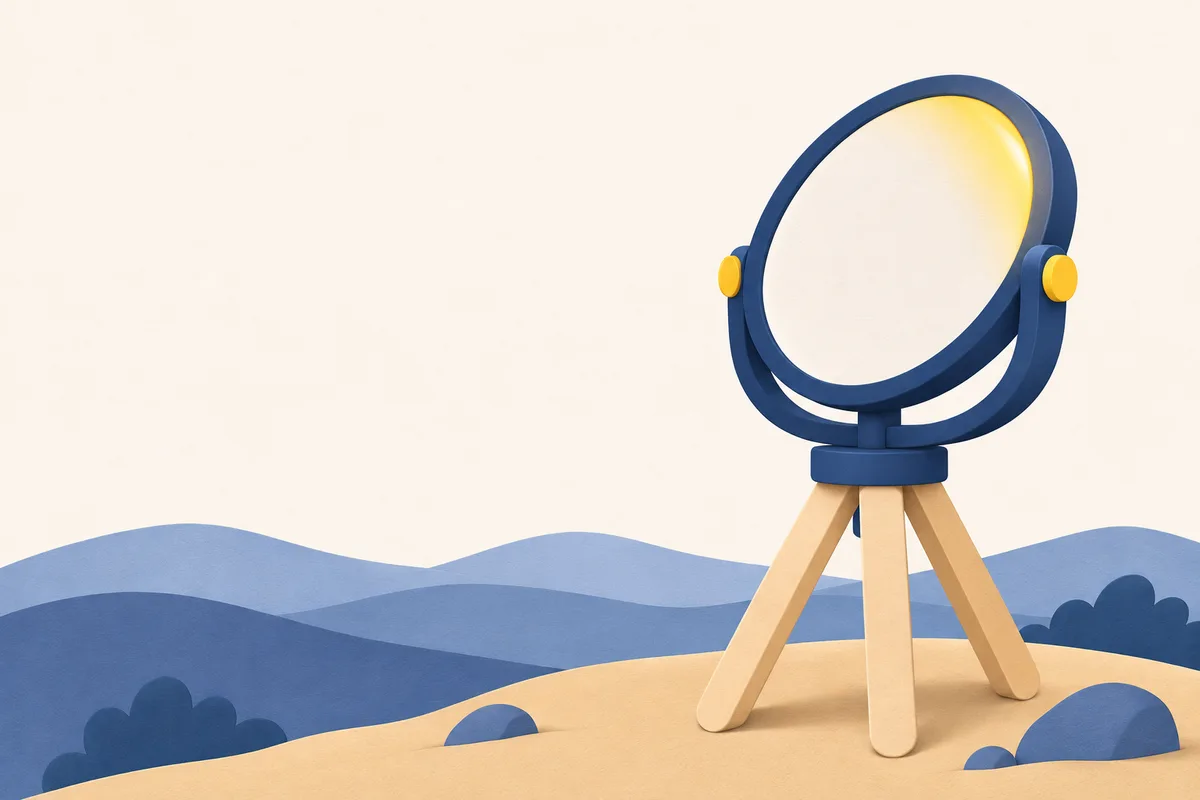
The Smithsonian describes it as a simple but effective solar telegraph that signals by flashes of sunlight reflected by a mirror, in widespread military use in the second half of the nineteenth century (Smithsonian). Royal Museums Greenwich records a model from about 1900. Its mirror sits in a fork on a tripod, with a small unsilvered spot at the center, and a lever on the mirror works as a Morse key (Royal Museums Greenwich). The National Park Service adds that the duration of the flashes corresponded to the dots and dashes of Morse code (National Park Service).
The American and British versions differed. Americans favored a fixed, square mirror and the British a tilting, round one; the square mirror gave 25 percent more reflecting surface for the same packing weight (National Park Service). Light is on or off, like a lamp, so the timing rules in Morse code with a flashlight apply here too.
When did armies use it?
The National Park Service's Fort Bowie site describes one campaign. General Nelson Miles first used the heliograph in Montana in 1878. In 1886, hunting Geronimo, he had 23 stations in Arizona and New Mexico, each about 25 miles from the next. A station on Bowie Peak kept a camp of five men, three operators and two guards, supplied by pack mules, and station number 2 sent 334 messages in the final campaign. On 5 June the Antelope Springs station saw Apaches moving toward Mexico, and the report reached the troops that went after them (National Park Service).
The British Army used it too. The National Army Museum has a photograph of a heliograph team in the Boer War, c. 1900, and says the army was still using heliographs as late as the 1950s (National Army Museum).
| Report | Miles | Kilometers |
|---|---|---|
| Longest recorded heliograph link, between mountains in Colorado and Utah (National Park Service) | 183 | 295 |
| Mirror flashes pilots have reported seeing, under ideal conditions (Army FM 21-76) | 99 | 160 |
These two numbers measure different things, so do not read one as better than the other. The first is a record link between two mountaintops. The second is what pilots have reported.
What limits a heliograph?
Sunlight. The Park Service says heliographs could reflect moonlight if needed but were generally closed at nightfall, and saw only intermittent use in the monsoon season. Miles chose them because mountains, clear air and plenty of sun suited the method (National Park Service). For a message after dark, Aldis lamp and signal lamps covers the lamp version.
How is a signal mirror used for rescue today?
The National Park Service's outdoor emergency plan lists a mirror as one of three ways to signal for help, with a whistle and a flashlight. It says flashing a mirror helps signal people if you are lost and that, unlike a flashlight, a mirror does not run out of battery. In its steps for a lost person, it says flashing the mirror can alert planes and helicopters flying in the area (National Park Service, 2023). For the remote Brooks Range, Gates of the Arctic National Park calls signal mirrors the least technologically advanced option and says they have been the most useful over the years, best used beside ground markings such as rocks, tarps or clothing arranged to spell HELP or SOS (National Park Service).
The Army's survival manual gives steps for its military mirror. Reflect the sun onto a nearby surface such as a hand, bring the mirror up to eye level and look through the sighting hole. The bright spot that you see is the aim indicator. Then tilt the mirror until that spot is on the target. The manual calls a mirror your best signaling device on a sunny day, and says that without one you can polish a canteen cup or belt buckle (Army FM 21-76).
The manual's survival advice includes two cautions. It says not to flash a signal mirror rapidly, because a pilot may mistake the flashes for enemy fire; it was written for soldiers. It also says not to hold the beam on an aircraft's cockpit for more than a few seconds, because it may blind the pilot (Army FM 21-76). Its advice also covers climbing to the highest point nearby if you can, and flashing toward the sound of an aircraft you cannot see (Army FM 21-76).
How do you aim a signal mirror without a sighting hole?
Use your hand as the sight. Be Ready Utah says to extend your arm and make a V with two fingers, point the arm and V at the person or object you want to reach, and angle the mirror so sunlight bounces between your fingers toward it. It says any mirror or reflective object works and that you should practice beforehand to find the best way to aim. For distress it says to flash in a repeated series of three (Be Ready Utah). The Army's sighting-hole method above is for a mirror made for that purpose.
The same Utah page says not to flash signals at aircraft unless you are in a survival situation (Be Ready Utah). The ground-to-air signals guide covers what else you can lay out for a pilot.
Do you need Morse code to signal with a mirror?
Not to be noticed. Yosemite's guidance for hikers says to use a mirror or reflective object to signal for help, and that any signal done three times in a series is a universal distress call (National Park Service). If you do know Morse, the Army manual describes SOS as three dots, three dashes, three dots, with a dot a short, sharp pulse and a dash a longer one (Army FM 21-76). To compare a mirror with other ways to call for help, see the distress signals guide.
A mirror is for when you cannot call emergency services. To practice the signal, press Flash above, or open the translator. The SOS guide has the background, the Morse code alphabet every letter, and How to learn Morse code by ear a way to start.
Sources
- Heliograph, object PH.328653. National Museum of American History, Smithsonian Institution, record read through the Smithsonian Open Access API, checked 7 November 2026.
- Heliograph, HELIO 5 MARK V (NAV0930), about 1900. Royal Museums Greenwich, checked 7 November 2026.
- The Heliograph, Fort Bowie National Historic Site. National Park Service, checked 7 November 2026.
- Heliograph team, about 1900, NAM. 1992-08-75-45. National Army Museum, London, checked 7 November 2026.
- Outdoor Emergency Plan. National Park Service, last updated 21 June 2023, checked 7 November 2026.
- Back Country Communications, Gates of the Arctic National Park & Preserve. National Park Service, last updated 22 December 2015, checked 7 November 2026.
- Wilderness Safety, Yosemite National Park. National Park Service, checked 7 November 2026.
- FM 21-76 Survival, chapter 19, Signaling Techniques (scan of the June 1992 manual). US Department of the Army, hosted by the Internet Archive, June 1992, checked 7 November 2026.
- Signaling. Be Ready Utah, State of Utah, checked 11 November 2026.